

When I bought my 22 acres outside Crossville back in 2019, I knew about six of them were going to be a problem. Privet, blackberry bramble, sweetgum saplings, old cedar along a collapsed fence line. The kind of growth that laughs at a string trimmer and turns a weekend into a war. I tried the usual things first. String line snapped, wrapped around stems, and ran out at the worst possible moment. A chainsaw worked but meant getting on my knees a hundred times a day. Somewhere in the middle of a summer two years back, I ordered the CALPALMY Brush Cutter Blade and Adapter Kit, three circular blades and two universal adapter sets in one box, and it changed how I clear ground.
This is not a review written after one afternoon of easy trimming. I have run this kit through two full seasons of privet, bramble, and saplings up to an inch and a half thick, on a straight-shaft trimmer I have owned for years. I have sharpened the blades, swapped the adapters, cussed at the instruction sheet, and figured out what the box does not tell you. Here is the long-term report.
The Quick Verdict
The CALPALMY kit is the fastest way I have found to knock down saplings and bramble on open ground, as long as you keep the blades sharp, keep the RPMs up, and stay away from rocks and fence wire.
Amazon Check Today's Price →What I Liked
- Three blade sizes in one kit: 9-inch 20-tooth, 9-inch 36-tooth, and 10-inch 80-tooth
- Two universal adapter kits included, so the hardware fits straight-shaft trimmers with a 1-inch arbor
- Alloy steel blades held up to two full seasons of privet, bramble, and saplings
- Thrust washers included, which most kits leave out
- The 20-tooth blade clears mixed growth far faster than string line
Where It Falls Short
- Will not fit ECHO SRM series trimmers, no matter what you do
- The 80-tooth blade is hard to sharpen by hand at home
- Real vibration at full RPM wears on your arms and shoulders
- The instruction sheet is thin; you will figure out the adapter order yourself
Stop fighting brush with string line
The CALPALMY Brush Cutter Blade Kit puts three blade sizes and two universal adapter sets in one box, so you can match the cutting edge to the job without buying three separate kits.
Amazon Check Today's Price on Amazon →How I've Used It
My setup is simple: a straight-shaft trimmer with a 1-inch arbor, the same one I have used for trimming fence lines for years. The CALPALMY kit is designed for straight shaft trimmers with a 1-inch arbor, and the dual universal adapter kits are what make it work. Each adapter set includes the hardware you need, thrust washers included, so the blade sits true on the shaft. That matters more than people think. A blade that wobbles will cut poorly, vibrate your arms numb, and work the nut loose.
I spent most of my time on the 9-inch, 20-tooth blade. That is the one I reached for when the growth was a mix of grass, bramble, and finger-thick saplings. The 9-inch, 36-tooth blade came out when I wanted a cleaner cut on heavier stems. The 10-inch, 80-tooth blade is the one I use for the thickest stuff, and it is the one that gets the most respect from me, because an 80-tooth blade spinning at trimmer speed will grab a stem and pull. You hold on, or you learn to.
The kit comes with three sizes for a reason. The 9-inch blades fit tight spaces and keep the weight down. The 10-inch blade reaches out and covers ground fast when you have open runs of saplings. I have also used the blades to cut through old cedar branches that fell across the fence line, and they handled wood up to a couple of inches thick without bogging down, as long as I let the blade do the work and did not force it.
One honest note: this kit is not for every trimmer. The compatibility list says it fits trimmers, weed eaters, chainsaws, and brush cutters, except the ECHO SRM series. If you own an ECHO SRM, this kit will not fit your machine, and no amount of adapter fiddling will fix that. Check your shaft and arbor before you order, not after.
What the Three Blades Actually Do
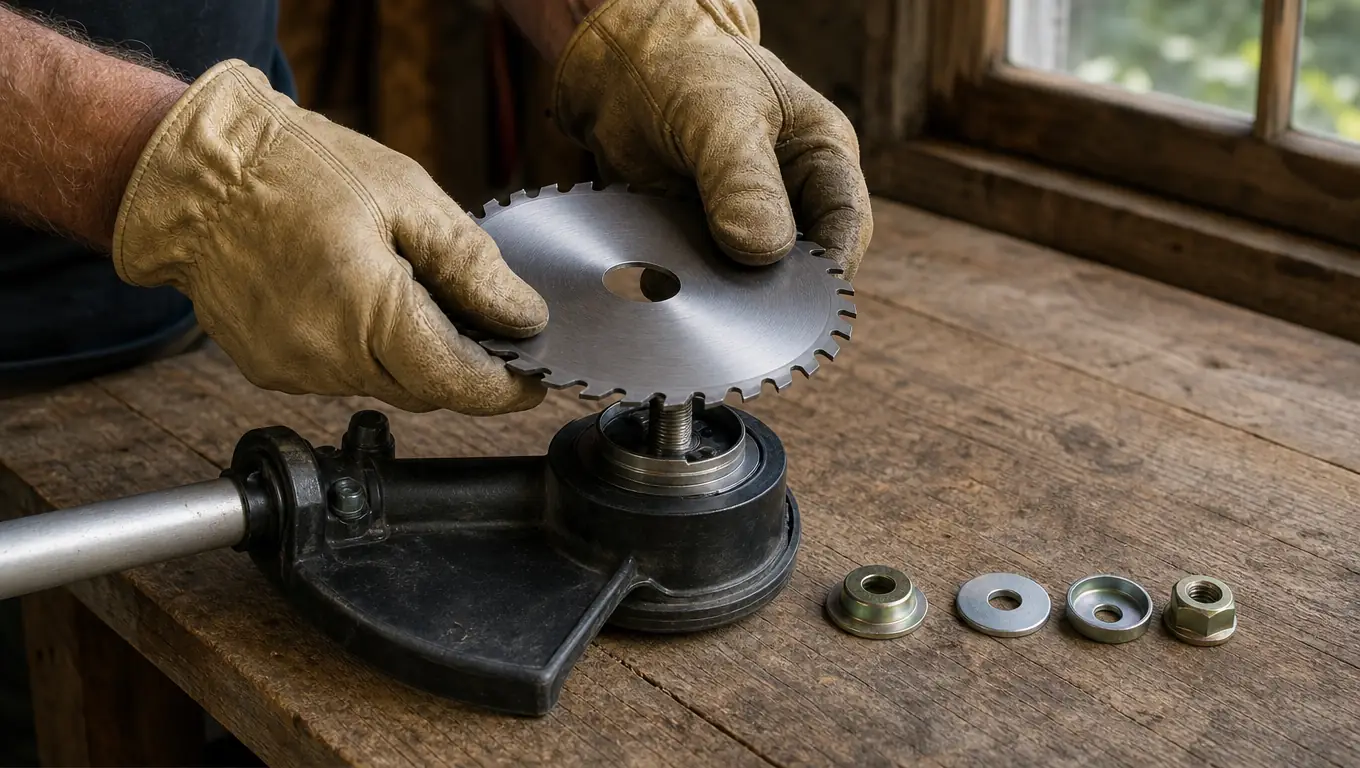
The CALPALMY kit includes three circular blades: a 9-inch, 20-tooth blade; a 9-inch, 36-tooth blade; and a 10-inch, 80-tooth blade. The tooth count changes the character of the cut more than the diameter does. Fewer teeth means a more aggressive, faster cut through thick stems, but a rougher finish. More teeth means a finer cut and a blade that runs smoother, but it needs more power to keep spinning through heavy growth.
The 20-tooth blade is the workhorse. On privet and blackberry bramble, it chews through stems without slowing down. The 36-tooth blade is the middle ground, and honestly, it is the one I use when I am cutting mixed growth and do not want to switch blades halfway through a row. The 80-tooth blade is the finisher. It leaves a cleaner edge on saplings and handles the thickest stems in the kit, but it is also the blade that demands the most from the trimmer.
All three are made from alloy steel, and all three have held up to two seasons of hard use. I have hit dirt with the 20-tooth blade more times than I care to admit, and it still cuts. It dulls, yes. Every blade dulls. But it does not bend or throw teeth the way cheaper blades have for me in the past.
Let me give you a specific day. In early July, I spent a Saturday morning on the worst stretch of the fence line, a 40-yard run where sweetgum saplings had grown up through the privet until you could not see the wire. I started with the 20-tooth blade and worked the outer layer down to knee height. Then I switched to the 36-tooth blade and took the remaining stubs down to the ground. By noon I had the whole run open enough to walk along the fence and check the posts. That same stretch had taken me three separate afternoons with string line the year before, and I still had not gotten it all.
The Adapter Kit: Where Most of These Kits Fail
Most brush cutter blade kits cheap out on the mounting hardware. You get one adapter, it fits one trimmer, and if it does not fit yours, you are stuck. The CALPALMY kit includes two sets of universal fitment hardware, and that is the detail that makes the kit worth the money. I have mounted these blades on my own trimmer and helped a neighbor fit them on his, and the second adapter set is what saved the day both times.
The thrust washers are the part people lose first. They are small, they fall off the workbench, and they roll under the tractor. The kit includes them, which is good, because running a blade without the thrust washer is how you end up with a loose blade at full RPM. I keep the spare hardware in a labeled bag in the shed now, because I learned that lesson the hard way.
Installation is straightforward if you have mounted a blade before. The instruction sheet is not a masterclass in clarity, but the parts are simple enough to figure out. Blade on the arbor, thrust washer, adapter, nut, tighten it down. The first time takes longer. The second time takes five minutes.
The first mount took me about 20 minutes and most of that was me reading the sheet twice and sorting the washers by size. The second blade took under five. The trick I found is to snug the nut down, then give it one firm pull with the wrench while you brace the blade against a block of wood. Check it again after the first few minutes of running, because the adapter seats in and the nut will settle. I have never had a blade come loose since I started doing that.
Sharpening and Maintenance
Sharpening is part of the deal with any brush blade, and the CALPALMY kit is no different. I keep a flat file in the shed and give the 20-tooth blade a few passes every couple of weekends. Ten minutes of filing keeps it cutting like new. The one time I let it go three weeks without sharpening, I could feel the difference in maybe ten seconds of cutting. The blade stopped pulling itself through the privet and started pushing against it instead. That is your sign to stop and file.
The nut check is part of my routine now. Every time I stop for a break, I give the blade a quick look and make sure the nut has not worked loose. It takes ten seconds. The one time I skipped it, I found the blade loose enough to rattle when I picked the trimmer up. That was a cheap lesson, and I have not skipped it since.

Long-Term Performance: What Held Up and What Did Not
After two full seasons, the honest answer is that the blades hold up better than I expected, and the edges do not stay sharp as long as I hoped. Alloy steel is tough, but it is not magic. Cutting through dirt, old fence wire, and the occasional rock will roll an edge. I sharpen the 20-tooth blade with a flat file every few weekends, and it comes back to life quickly. The 80-tooth blade is harder to sharpen by hand because of the tooth count, so I use it for the thickest work and take it easy on the dirt.
The vibration is real. A circular blade spinning at trimmer speed is not a string head. You feel it in your hands, your arms, and your shoulders after a few hours. Good gloves help. Taking breaks helps more. I run the trimmer at full throttle and let the blade cut at its own pace, and that keeps the vibration down better than forcing it through thick growth.
The wood chips are another thing nobody tells you. A string head throws grass clippings. A brush blade throws wood chips and small debris like shrapnel. Safety glasses are not optional. Neither is long pants and a long-sleeve shirt. I learned this when a piece of privet bounced off my shin and left a bruise the size of a walnut.
Wear and tear after a year: the 20-tooth blade has a couple of nicks on the edge from a hidden rock, but they filed out clean. The 36-tooth blade still looks close to new because it mostly cut green stems. The 80-tooth blade has lost a little of its edge from the thickest cedar, and I have started sending it out for sharpening rather than fighting it with a file. The adapters show no wear at all, which tells me the steel there is plenty hard. I also replaced the trimmer head once during the year, and the CALPALMY hardware transferred straight over with no trouble.
I cleared a 60-foot stretch of privet and bramble in about 20 minutes with the 9-inch, 20-tooth blade. That same stretch had eaten two full spools of string line the year before.
Who This Is For
This kit is for the landowner who is done fighting brush with string line. If you have a straight-shaft trimmer with a 1-inch arbor, and you spend your weekends clearing fence lines, saplings, privet, and bramble, the CALPALMY kit will save you hours every single time you go out. It is also for the person who wants options without buying three separate kits. Three blade sizes, two adapter sets, one box.
It is also for the person who has one specific job and wants the right blade for it. The 20-tooth blade is the everyday choice for mixed growth. The 36-tooth blade is the one to grab when you want a cleaner cut and the growth is mostly green. The 80-tooth blade is for the thickest saplings and the jobs where you are willing to trade a rougher ride for raw cutting power. Having all three in the same box means you are never stuck with the wrong edge for the day.
Who Should Skip It
Skip this kit if you have an ECHO SRM series trimmer, because the compatibility list says it will not fit, and I am not going to tell you otherwise. Skip it if your ground is full of rocks, old wire, and buried junk, because no steel blade handles that forever, and you will spend more time sharpening than cutting. Skip it if you only need to trim grass around the mailbox, because a brush blade is the wrong tool for that job, and it will tear up your yard.
And if you are hoping this kit turns a handheld trimmer into a forestry mulcher, it will not. It is a homeowner and landowner tool, a good one, but it has limits. For trees over two or three inches thick, I still reach for a chainsaw. For a full acre of heavy brush, I still rent a tractor with a brush hog. The CALPALMY kit fills the gap between those two, and that gap is bigger than most people think.
The kit that made string line obsolete for me
Three CALPALMY blades, two universal adapter sets, and two seasons of proof that a straight-shaft trimmer can clear real brush. If your trimmer takes a 1-inch arbor, this is the upgrade.
Amazon Check Today's Price on Amazon →