
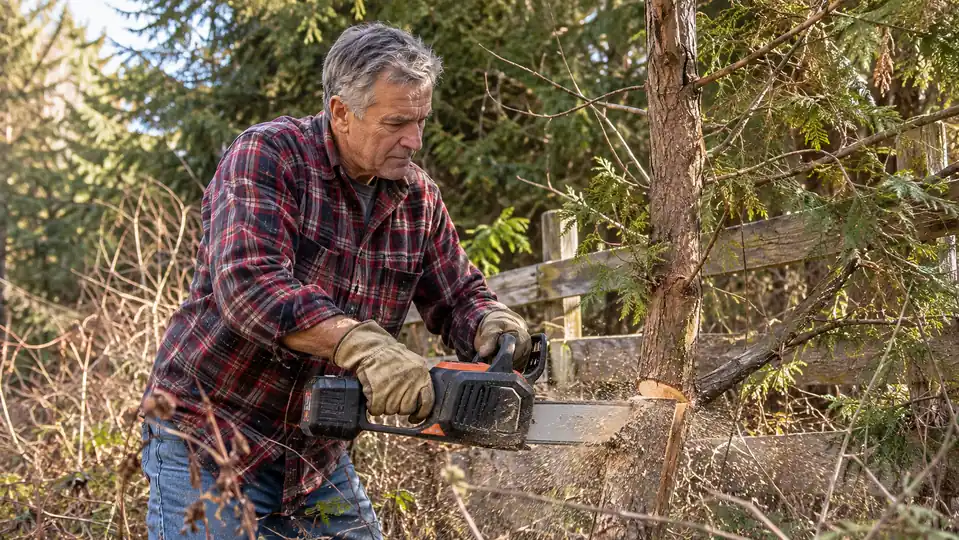
When I bought my 22 acres outside Crossville, Tennessee in 2019, I figured the first tool I needed was a gas chainsaw. Every man on my road told me the same thing, and I believed it for about a season. Then I spent one too many mornings pulling a cord on a cold saw while the privet waited, and I picked up the Greenworks 40V 16-inch brushless chainsaw to see if the battery crowd was onto something. Two years later, it is the saw I reach for first for most of what this place needs.
To answer the headline directly: for clearing land, which means saplings, blackberry bramble, old cedar and the occasional blowdown, the Greenworks is the better tool for most of my work. For long days of bucking big hardwood, a gas saw still earns its place in my shed. This is the honest version of that comparison, from a man who has run both on the same ground.
Why I Made the Switch
The switch did not happen because I wanted to be early to anything. It happened because the gas saw and I had a bad relationship. It sat in the shed for months at a time, and every time I needed it, the fuel had gone stale or the carburetor needed attention or the cord would not cooperate on a cold morning. A chainsaw that lives in the shed and argues with you is not a tool. It is a chore.
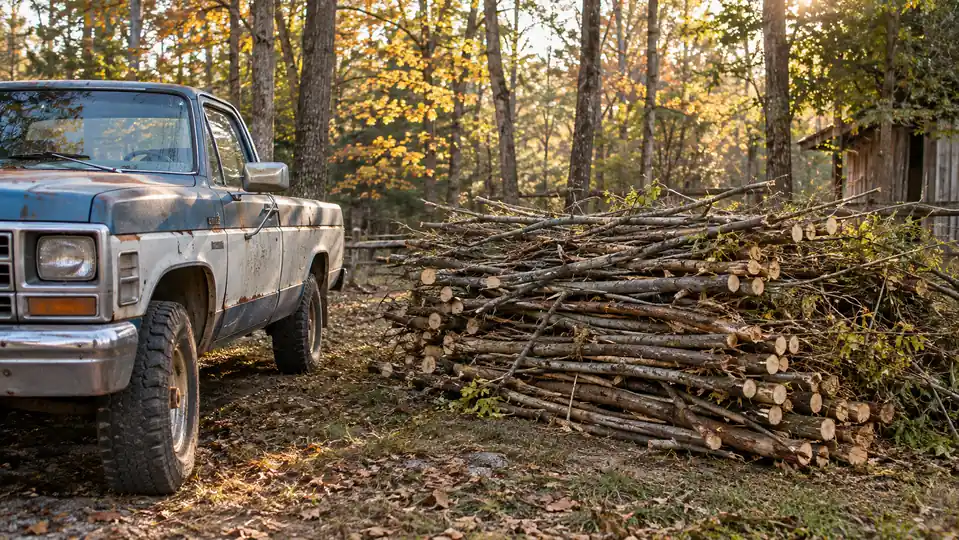
The land pushed me over the edge. Six of my 22 acres were a mess of privet, blackberry bramble, sweetgum saplings and old cedar along a collapsed fence line. That is not big timber work. It is hundreds of small cuts, most of them at ground level or waist height, and it is exactly the kind of job where a light saw that starts instantly is worth more than a heavy saw with more power than the work demands.
I still own a compact utility tractor for the heavy dragging, and I still keep a gas saw for the days that call for it. But the Greenworks is what I carry when I walk the fence line, because it is the tool that matches the job most days of the year.
| Greenworks 40V 16-inch Brushless | Comparable Gas Chainsaw | |
|---|---|---|
| Starting | Two-step easy start, no gas, no prime, no pull cord | Pull start; can be stubborn when cold or after sitting all winter |
| Runtime | Runs until the 4.0Ah battery is spent, then it charges | Runs as long as fuel is in the tank; refill in under a minute |
| Weight | 10.4 pounds, easy to carry one-handed while you drag brush | Comparable gas saws usually weigh more, and you feel it by hour three |
| Maintenance | Automatic oiler; keep the chain sharp and the battery charged | Fuel mix, air filter, spark plug, carburetor, and draining the tank before it sits |
| Cutting power in hard wood | 16-inch bar and 1.5kW brushless motor handle trees up to 28 inches in diameter | More sustained torque on long cuts in oak and cedar |
| Noise | Quiet enough to hear the chain and talk over it | Loud; hearing protection is non-negotiable |
| Storage between jobs | Battery holds its charge for 12+ months, grab it and go | Gas goes stale and carburetors gum up if the saw sits |
| Best for | Clearing saplings, brush, storm cleanup and weekend work | Full days of felling and bucking big timber |
Where the Greenworks Wins
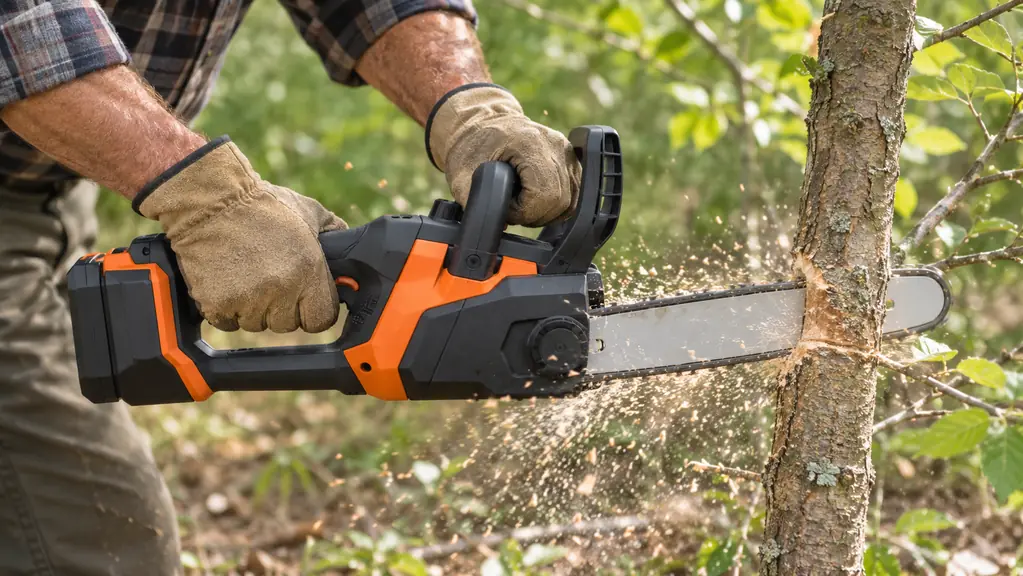
The starting difference is the one you feel every single time. With the Greenworks, the two-step easy start means no gas, no prime, no pull cord. No choke, no primer bulb, no pulling a cord twenty times while your fingers go numb. On a wet January morning with frost on the bar, that is the difference between an hour of work before breakfast and an hour spent fighting the saw.
The other win is weight and maintenance. At 10.4 pounds, the Greenworks is light enough that I carry it in one hand while I drag a cut sapling out of the way with the other. There is no fuel mix to measure, no carburetor to tune, no spark plug to foul. The automatic oiler keeps the bar lubricated, and my entire maintenance routine is charge the battery, keep the chain sharp, check the tension. That is the whole list.
Where a Gas Chainsaw Wins
A gas saw wins the long days. When I have a dozen sweetgums down and a full day of bucking ahead of me, the Greenworks runs until the 4.0Ah battery is spent, and then I stop. I wait on the charger or I plan the work around the charge, and neither is as fast as pouring fuel in a tank and pulling the cord once. For sustained cutting in hardwood, a comparable gas saw keeps its torque where a battery saw tapers off as the charge drops.
The other thing a gas saw does better is pull through a long cut in dense wood. The 1.5kW brushless motor in the Greenworks is genuinely good, and the 16-inch bar will handle trees up to 28 inches in diameter, but torque over a sustained cut is where gas still leads. When the bar is buried in green oak, a gas saw keeps pulling where a battery saw wants to slow down. If I were felling big timber every weekend, I would own gas and I would not argue about it.
For saplings, brush and storm cleanup, I grab the Greenworks. For a full day of bucking big timber, I still want gas.
For clearing saplings and brush, this is the saw I reach for
The Greenworks 40V 16-inch brushless chainsaw comes with the 4.0Ah battery and charger in the box, so there is nothing else to buy before your first cut. If your land looks like mine did in 2019, this is the saw that makes the work feel possible.
Amazon Check Today's Price on Amazon →What the Specs Sheet Actually Tells You
The numbers worth knowing are these. The Greenworks 40V 16-inch brushless chainsaw runs on a 4.0Ah lithium-ion battery that holds its charge for 12 or more months, so it sits in my shed between jobs and starts when I need it. The 1.5kW brushless motor and the 16-inch bar are rated for trees and limbs up to 28 inches in diameter, which covers everything I cut on my place except the biggest blowdowns.
It weighs 10.4 pounds, which matters more than most people think when you are cutting low and reaching into bramble. The automatic oiler keeps the bar lubricated while you work, and the two-step easy start means no gas, no prime, no pull cord. There is a chain brake and a low-kickback design, and the whole thing carries a 3-year manufacturer warranty.
None of that makes it a logging saw. It makes it a serious homeowner and landowner saw that happens to run on a battery. The people who dismiss battery chainsaws are usually comparing a cheap one to a pro gas saw. This is not a cheap one.
The Cost of Owning Each One
I am not going to quote prices, because they move. But I will tell you where the money goes. With the Greenworks, the battery and charger are in the box, and the list of things that wear out is short: the chain, the bar, and eventually the battery. There is no fuel to buy, no oil to mix, no carburetor to rebuild, no spark plug to replace.
With a gas saw, the register price is only the beginning. You buy fuel, 2-cycle oil, bar oil, and a can to carry them in. You replace air filters and spark plugs and fuel lines, and if the saw sits for months, you either drain the tank or pay a small engine shop to clean the carburetor. Over five years on a place like mine, the battery saw is the cheaper tool even before you count the hours it saves you.
Safety Notes From the Fence Line
I spent 30 years on a county road crew, so I will say this plainly: the chain does not care how experienced you are. The Greenworks has a chain brake and a low-kickback design, and I use the brake every time I move between cuts. I wear chaps, I wear eye protection, and I keep both hands on the saw. A battery saw is quieter than gas, which is pleasant, but it still deserves the same respect.
The quiet is a real safety advantage in one way: you can hear the chain and the wood, and you can hear a branch cracking overhead before it comes down. With a gas saw running at full noise, you miss some of that. I consider the lower noise a genuine safety feature, and I did not expect that when I bought it.
Alternatives I Considered
Before I settled on the Greenworks, I looked at other battery saws and at staying with gas. The gas option I already owned, so the question was whether a newer gas saw would fix the starting and storage problems. It would not. The problems are built into the platform: fuel goes stale, carburetors gum up, and a pull start is a pull start.
The other battery saws in this class were close, but the combination of the 16-inch bar, the 4.0Ah battery, the automatic oiler, and the 3-year warranty is what tipped it for me. I wanted a saw that came with everything in the box and did not ask me to buy a bigger battery before I had even cut one log.
Who Should Buy Which
The rule I give neighbors is simple. If your work is saplings, brush, storm cleanup and cutting firewood in short sessions, buy the Greenworks and do not look back. If your work is felling big timber, or you spend eight hours a day with a saw in your hands, buy gas. If you are like me, with six overgrown acres and a weekend to work them, the battery saw does the job with none of the fuss, and the gas saw stays in the shed for the days that truly need it.
One more thing worth saying: the Greenworks is not a toy and it is not a compromise. It is a 16-inch brushless saw with a chain brake and a low-kickback design, and it will cut everything a 22-acre place throws at it in a normal year. The people who tell you battery saws are weak have usually never run a good one.
How I Tested It on My Place
I did not test this saw in a lab. I used it on the collapsed fence line where the privet and blackberry bramble had taken over, the same ground that convinced me I needed a gas saw in the first place. Over two seasons I cut hundreds of sweetgum saplings, cleared old cedar, and bucked up the blowdowns that come with Tennessee weather.
The pattern that emerged is consistent. For anything up to about six inches through, the Greenworks cuts as fast as I can feed it. For the bigger stuff, I slow down and let the saw work. The chain brake and the low-kickback design give me confidence when I am reaching into a tangle of bramble where I cannot see the whole cut, and the automatic oiler means the bar is never running dry when I need it.
The honest drawback showed up on the long days. When I had a dozen trees down and the afternoon was burning away, the 4.0Ah battery eventually gave out and I stood there waiting on the charger. That is the tradeoff in one sentence: the Greenworks makes every short job easier, and a gas saw makes the long job possible.
The Bottom Line
If you are clearing your own land and you are not a logger, the Greenworks 40V is the better buy. It starts every time, it weighs 10.4 pounds, it holds its charge for 12 months, and it cuts everything a 22-acre place needs cut in a normal year. The gas saw in my shed still earns its keep on the worst days, but it is no longer the first saw I reach for. That is the whole answer.
Start with the saw that starts every time
The Greenworks 40V 16-inch brushless chainsaw with the 4.0Ah battery and charger included is the saw I reach for first on my place. Check today's price on Amazon and see if it fits your land the way it fit mine.
Amazon Check Today's Price on Amazon →