
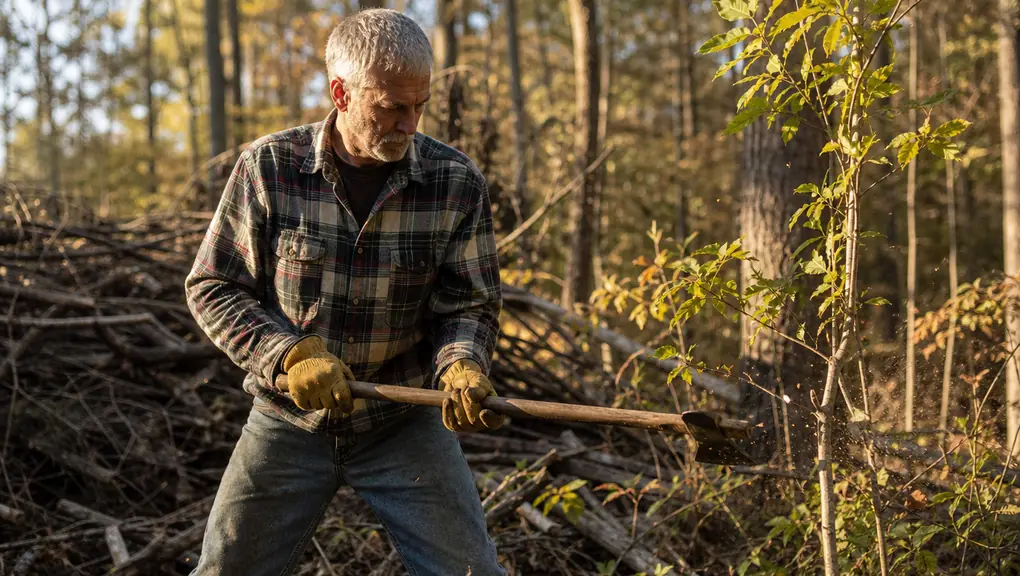
The first time I carried the Fiskars Brush Axe down to the old fence line, I figured it would last one good season of hard use and then start to rattle. That was three summers ago. The privet and blackberry bramble along that collapsed fence have taken a beating since then, and so has the axe. It is still going, and it is still tight. I bought it on the word of a neighbor who cleared ten acres of cedar with one.
I bought the place in 2019, 22 acres outside Crossville, Tennessee. About six of those acres were so overgrown you could not walk them. Privet thick enough to hide a deer, blackberry canes that grabbed at your pants, sweetgum saplings and old cedar tangled along a fence line that had fallen years before. I spent the first few seasons on it with a chainsaw, a machete, and a lot of bad language. I am not a young man anymore, so a tool that wears me out is a tool that stays in the shed. The brush axe came later, and it changed which tool I reach for first.
The Quick Verdict
For clearing bramble, privet and saplings on a few acres, this is the tool I reach for first. It is light enough to swing all afternoon and tough enough that three seasons in, the blade is still tight in the handle.
Amazon Check Today's Price →The brush axe I keep coming back to
Three summers of clearing privet, bramble and sweetgum saplings and this is still the first tool I grab. If you are facing the same kind of overgrowth, it is worth a look at today's price on Amazon.
Amazon Check Today's Price on Amazon →How I've Used It
The section of fence line I started on runs about 300 feet along the back of the property. It was the worst of the six acres, a wall of privet with blackberry woven through it and sweetgum saplings pushing up through the middle. I cleared it in chunks, an hour or two at a time, usually in the late afternoon when the heat let up.
My pattern is simple. I cut the big stuff first, anything wrist-thick or bigger, with the chainsaw. Then I work the brush axe through what is left. One swing lays a privet stem over, a second cut frees it from the tangle, and I drag it to the pile. For blackberry canes, I do not even swing hard. The weight of the blade does the work, and the curved edge pulls through the cane instead of bouncing off it.
I have used it on every kind of growth on the place: privet, blackberry, sweetgum, cedar, honeysuckle vines, and the occasional volunteer locust. I have also used it to strip branches off cedar logs I wanted to keep for posts, and to cut a trail through a patch of brush that was too thick to walk. In three seasons it has not once let me down.
A word on safety, because I have the scars to prove it matters. I wear leather gloves and eye protection every time I use it, and I put the sheath back on before I carry it anywhere. The blade is sharp enough that you will not always feel a cut until you see the blood. It takes two seconds to be careful and a lot longer to explain an emergency room visit.
What the Specs Actually Tell You
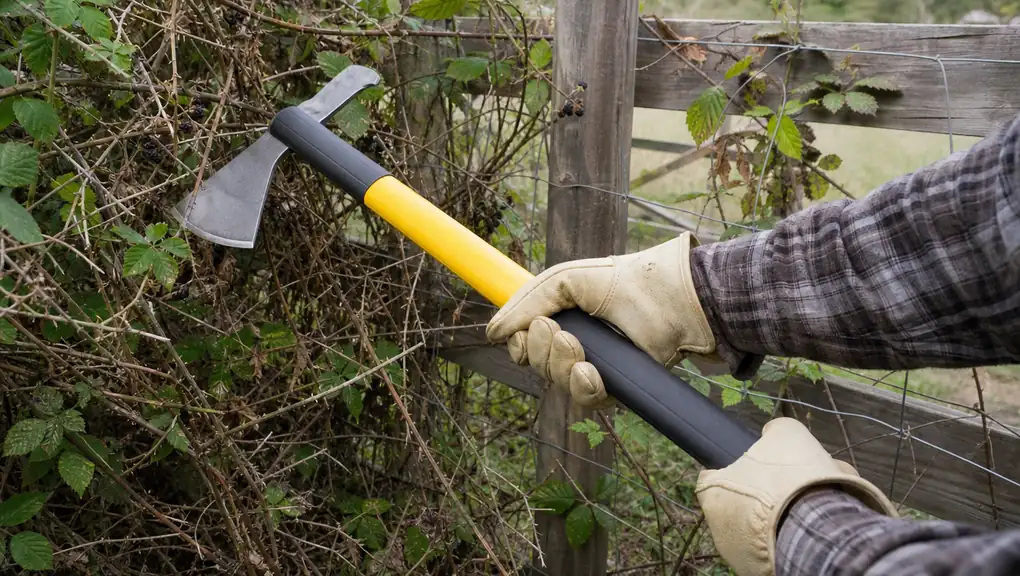
The numbers on the box are easy to dismiss, but they are the whole story. The blade is a 10-inch curved edge, and the handle is 19 inches of Fiskars FiberComp, their fiberglass composite. The whole thing weighs 1.2 pounds. The blade is stainless steel, which matters when you are working in wet brush and you are not always good about wiping things down. That weight is the reason it works. A heavier axe wears you out in twenty minutes. This one you can swing for two hours and still have your arms at the end.
The curved blade matters more than I expected. On a straight machete, a cut on a privet stem tends to glance off if you are not square. The curve catches the stem and pulls it through the cut. The low-friction coating keeps the blade from sticking in green wood, which is the difference between a clean swing and one that stops dead halfway through a cane.
The other spec worth noting is the way the blade is attached. Fiskars insert-molds the blade into the handle, so there is no head to loosen and no rivet to work its way out. I have had plenty of tools where the head started to wobble after a season. This one has not moved a millimeter in three years. The sheath it comes with is simple and it works, and the full lifetime warranty is the kind of thing you hope you never need.
How It Holds Up Over Time
The honest answer is that I expected the edge to chip. I have used it on cedar, which is hard and full of knots, and on sweetgum, which is stringy and grabs at the blade. I have hit dirt with it more times than I want to admit, usually when a cane folded instead of cutting. The edge has rolled in a couple of spots, and a few minutes with a sharpening stone brought it right back. That is normal maintenance, not a failure.
The handle has held up better than any fiberglass handle I have owned. It does not splinter, it does not flex, and it has never felt like it was going to come loose. The handle still feels solid in my hand after three seasons of sweaty hands and muddy gloves. I have left it leaning against the porch overnight in the rain more than once, and it has not complained.
The one thing I do is keep it clean. After a day on the fence line I wipe the blade down and give it a light coat of oil before it goes back in the sheath. That takes two minutes. Tools last when you do the two minutes.
Where It Earns Its Keep
The brush axe shines in the stuff that eats a chainsaw. Privet, blackberry, honeysuckle, multiflora rose, all the tangle that grows up along a fence line and makes you wonder where the fence even is. A chainsaw bogs down in that mess and you spend half your time clearing the bar. The brush axe just cuts through it.
It is also the right tool for saplings up to about an inch and a half. A single swing cuts a sweetgum sapling clean at the base. Two swings if you are tired or the angle is bad. For anything bigger than that I go to the chainsaw, but the brush axe handles the little stuff so fast that the chainsaw stays in the truck more often than not. I have cut a lot of sweetgum this way, and it is the closest thing to satisfying work I have found on this place.
The third job it does well is trail cutting. When I wanted to open a path through a patch of brush to get to a downed tree, the brush axe was the tool I carried. It clears a path without the noise of a chainsaw, and it does not leave a mess of half-cut canes the way a machete can.
The other job I did not expect is stripping logs. When I cut a cedar for fence posts, the brush axe makes short work of the branches. A couple of quick pulls with the curve of the blade and the limb is off clean. It is faster than walking back to the truck for the chainsaw, and it leaves a better post.
What Else I Tried Before This
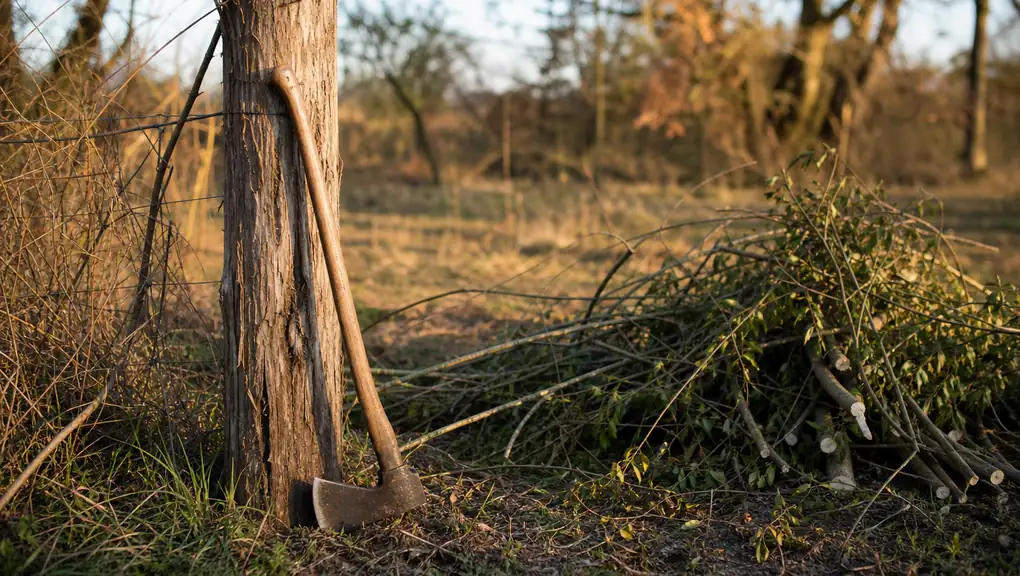
I did not start with the brush axe. I started with a machete, because that is what everyone says to buy for brush. The machete worked on single canes, but in a real tangle it bounced off the thicker stems and wore my wrist out. It also did not have the reach or the weight to cut a privet stem in one pass. I still own it, but it mostly lives in the truck now.
I tried loppers, and they are fine for a single stem you can reach. The problem is that you spend half your time bending over, and the other half fighting canes that grab the handles. I tried a hatchet too, and a hatchet is the wrong tool for this work because the short handle puts your hand right in the middle of the tangle. The 19-inch handle on the brush axe is the difference. It keeps your hand out of the thorns and gives you leverage to cut through the thick stuff.
The chainsaw is still the king for anything big, and I do not see that changing. But the chainsaw is loud, it is heavy, and it needs fuel and attention. For the steady work of clearing a fence line, the brush axe is what I reach for. It is quiet, it is light, and it is always ready. It is the difference between a chore and a job I look forward to.
The Tradeoffs You Need to Know
I will not pretend this tool does everything. It is not a stump grinder, and it is not a chainsaw. For anything wrist-thick or bigger, or for anything that needs to come out at ground level, you want the right tool for that job. The brush axe cuts stems and canes. It does not dig roots, and it is not the tool for a tree that is six inches through.
It also takes a little technique. If you swing it like a hatchet, straight down, the curved blade wants to pull sideways. The right way is a diagonal swing, letting the curve do the work. Once you find that angle, it cuts like it is supposed to. Before you find it, you will feel like you are fighting the tool. Give it an afternoon and it will click. Once it clicks, you will wonder why you ever fought it.
The other tradeoff is that a brush axe is a one-handed tool doing a two-handed job in heavy brush. For the worst of the privet, I still use the chainsaw first and the brush axe second. And for the kind of overgrown acreage where you cannot even see the ground, I have rented a forestry mulcher twice. That is a different world, and it is worth it when the job is too big. The brush axe is the tool for the work in between, the steady acre-by-acre clearing that most of us actually have.
What I Liked
- Weighs just 1.2 pounds, so it is easy to swing for hours without your arm giving out
- Curved 10-inch blade pulls through bramble and privet instead of bouncing off
- Insert-molded blade has stayed tight through three seasons of hard use
- FiberComp handle is tough, does not splinter, and keeps your hand out of the thorns
- Comes with a safety sheath and a full lifetime warranty
Where It Falls Short
- Edge will roll if you hit dirt or rocks, so carry a sharpening stone
- Not the tool for anything thicker than about an inch and a half
- Takes an afternoon to learn the right diagonal swing
- Will not dig roots or handle stumps, no matter how you swing it
Three summers and a couple thousand swings into it, the blade is still tight in the handle. That is the thing I did not expect.
Who This Is For
If you have a few acres of overgrown fence line, a patch of bramble, or a trail that needs opening, and you would rather spend a Saturday working through it than paying somebody, this is for you. If you are the kind of person who likes a tool that does not need a battery, a fuel can, or a trip to the shop, this fits the bill. It is the tool for the person who is not trying to clear the whole property in a weekend, just the next section. It is also for anyone who wants a blade they can carry all day without their arm giving out by noon.
Who Should Skip It
If your idea of brush is a couple of saplings you can cut with a pair of loppers, you do not need this. If you are facing trees thicker than your wrist, or stumps that have to come out, this is not the tool and no amount of swinging will make it one. And if you are not willing to sharpen a blade now and then, buy something with a motor. The Fiskars Brush Axe is a hand tool, and it expects you to treat it like one. That is not a criticism of the tool. It is a compliment.
Ready to take on your own fence line?
Three seasons in, this is still the first tool I grab when the brush needs to move. If you have overgrown acreage of your own, check today's price on Amazon and see if it earns a spot in your truck too.
Amazon Check Today's Price on Amazon →