
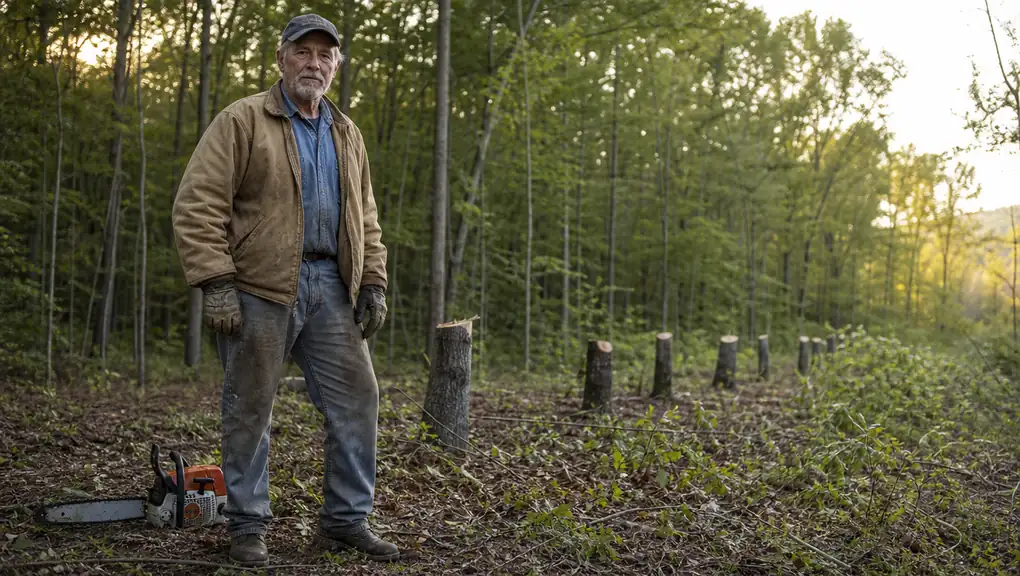
Every spring for three years, the sweetgum stumps along my fence line sent up a new crop of sprouts. I cut them down, and they came back thicker. I cut them again, and they came back again. I was fighting the same fifty or sixty stumps on a loop, and losing. That is the problem Bonide Stump-Out is supposed to solve, and after two seasons using it, I can tell you exactly what it does and what it does not do.
If you are hoping for a pour-it-on-and-walk-away fix, this review will save you some money. Bonide Stump-Out is not that. It is a tool with a specific job, and it only works when you set it up right. Used the way the label intends, on a fresh cut, it stopped every treated stump on my place from sprouting. Used the way most people probably use it, on an old dry stump, it will look like a waste of money. Most of the one-star reviews are people in the second group.
The short version, before I get into the weeds: this product kills stumps and stops sprouts, but it does not remove the wood. It is a stump killer, not a stump remover. Keep that difference in your head and you will be happy with it. Forget it and you will join the crowd writing the one-star reviews.
The Quick Verdict
A solid stump and brush killer that stops regrowth when you apply it to a fresh cut. It will not remove the stump or speed up rotting. Buy it for the sprouts, not for the wood.
Amazon Check Today's Price →Stop fighting the same stumps every spring
Bonide Stump-Out kills the stump and stops the sprouting when you treat a fresh cut the same day you make it. Check today's price on Amazon and see if it fits your clearing job.
Amazon Check Today's Price on Amazon →How I've Used It
I bought this place in 2019, 22 acres outside Crossville, Tennessee, and about six of them were a mess. Privet, blackberry bramble, sweetgum saplings, and old cedar all tangled up along a collapsed fence line. I have been clearing it in sections ever since, a little at a time with a chainsaw and my compact tractor. The cutting was not the hard part. The hard part was that everything I cut came back.
Sweetgum is the worst of the bunch. You cut a sapling down to a two-inch stub, and within a month it has a collar of new shoots around the rim. Mow them, and they come back with more. I tried cutting them low and walking away, and I tried coming back every few weeks to knock the sprouts down. Both plans meant I was doing the same job every month from April to October.
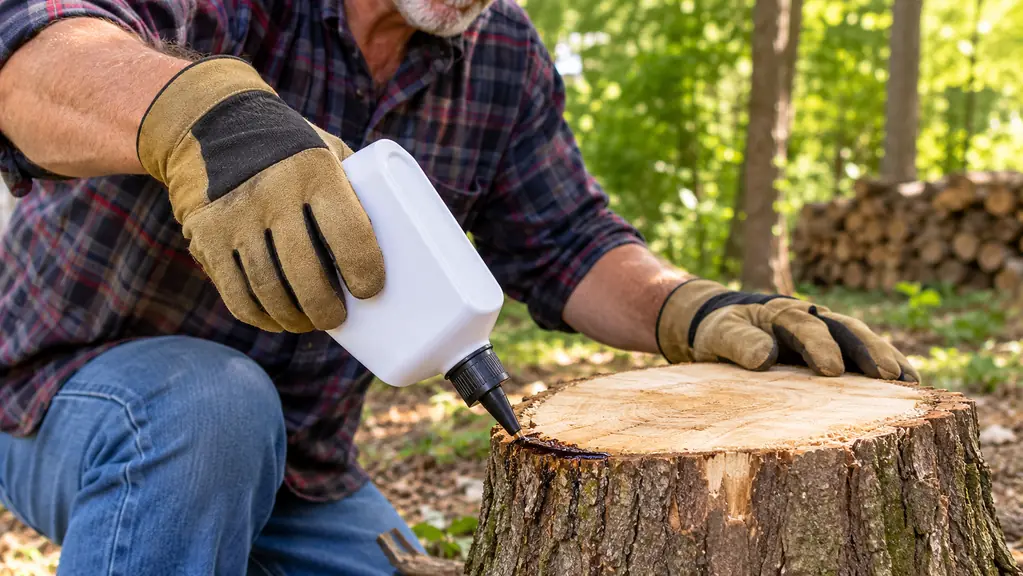
Two springs ago I finally did it the way the county crews would have, which is embarrassing to admit since I ran a county road crew for thirty years. I cut the saplings, and the same day, I opened the 8-ounce bottle of Bonide Stump-Out and worked the included applicator over the fresh cut, concentrating on the outer ring of the stump where the live tissue is. It took maybe thirty seconds per stump. I treated a long stretch of fence line in an afternoon.
I used the rest of the bottle on privet stumps along the same line. Privet is another one that mocks you if you just cut it. The Bonide handled it the same way, applied to the fresh cut, no sprouts since. I also mixed a batch for the tank sprayer and hit a patch of bramble and broadleaf weeds along the walkway, which the label covers. The weeds were brown within a couple of weeks.
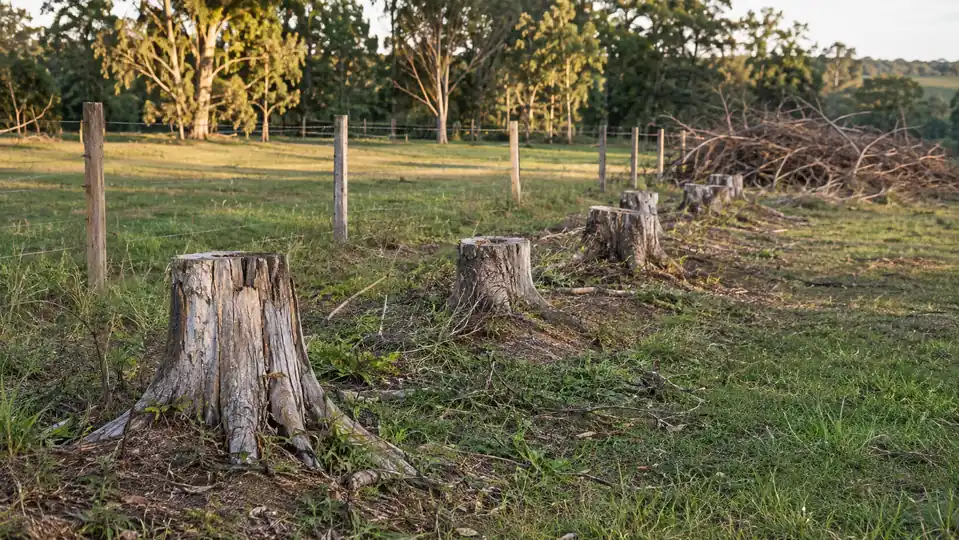
I marked the treated stumps with a few dabs of spray paint so I could tell them from the ones I skipped. That turned out to be the most useful habit of the whole project, because it gave me a clean comparison by midsummer. The treated side of the fence line stayed quiet. The untreated stumps I had cut and left for later were covered in sprouts. Same soil, same weather, same day cutting. The only difference was the bottle.
Through June and July I walked that fence line every couple of weeks, mostly to check the tractor path and keep the blackberry from creeping back. Every time, the treated stumps looked the same: grey, dry, quiet. No collar of shoots, no green on the cut face. The untreated stumps I had skipped were a different story, and by August I had my answer without any guesswork.
What It Actually Does (and What It Does Not Do)
Here is the honest breakdown. Bonide Stump-Out is a herbicide, and it works through the cut. The active ingredient, 3,5,6-Tricloro-2-Pyridinyloxyacetic Acid, goes on the cut surface and the stump pulls it down into the root system. That is what kills the stump and stops it from sprouting. It is not a surface burn. It works from the inside.
The part the marketing does not shout about: this product kills the stump. It does not remove it. A lot of people hear 'stump killer' and picture the stump turning to mulch in a month. That is a different product, or more accurately, a different process. Bonide Stump-Out stops the living tissue from sending up shoots. The wood itself still has to rot, and that takes a couple of years in Tennessee weather, longer for a big cedar. If you need the ground level by next weekend, you need a stump grinder or a dozer, not this bottle.
The label says it eliminates weeds within 1 to 6 weeks, and that matched what I saw. The bramble and broadleaf weeds I sprayed were clearly dead inside two weeks. The stump treatment is slower to show, because the visible result is simply that nothing comes up. No drama. The stump just sits there and rots, and the sprouts never appear. That is the whole job, and it does it.
Do not expect the stump to change much. That is the part that surprises people. The wood does not blacken or split or shrink in any dramatic way. It just stops growing. The cut face dries, the bark loosens a little, and the stump sits there looking like a stump while the rot takes its time. If you are checking every week for a visible sign, you will think it failed. The sign is what does not happen: no sprouts.
It also covers what the label lists: stumps, woody plants, vines, and broadleaf weeds, for outdoor use around homes, cabins, fences, and walkways. I stayed within that. I did not use it anywhere near the garden, and I kept it off the oaks I want to keep. Any herbicide deserves that respect.
The applicator deserves a word, because it is the difference between a tidy job and a mess. The bottle comes with its own applicator, so you are not fumbling for a brush or a rag. I kept one pair of nitrile gloves dedicated to this job, worked the product around the rim of each stump, and put the bottle back in the shed. No drips on the grass, no puddle in the bottom of the bucket, no cleanup beyond rinsing the applicator. For a product like this, that matters.
What I Liked
- Stops sprouting for good when applied to a fresh cut the same day
- Easy to apply with the included applicator, no extra tools needed
- One 8-ounce bottle treated fifty or sixty stumps on my fence line
- Also works as a foliar spray for vines, bramble, and broadleaf weeds
- Results on foliage showed within two weeks, within the label's 1 to 6 week window
Where It Falls Short
- Does not remove the stump or speed up rotting, the wood stays for years
- Only works on fresh cuts, useless on old dry stumps
- Small bottle, you will want more than one for a big clearing job
- It is a chemical, gloves and care are required around trees you want to keep
- Timing matters, treat in late summer or fall for the best uptake
The Mistakes That Make People Say It Does Not Work
I read a lot of reviews before I bought this, and the pattern in the bad ones is unmistakable. People treat an old stump. A stump that has been cut for months, dried out, grey on top, is not going to pull anything down into its roots. The cut has to be fresh, same day if you can manage it, so the stump is still alive and still transporting. Treat a dry stump and you are just wetting dead wood.
The second mistake is treating the middle of the stump. The live tissue that carries the chemical is the outer ring, just under the bark. If you pour the product into the center of a big stump, most of it sits on dead heartwood and goes nowhere. You want the applicator on the rim, where the sap is still moving. That is the difference between a stump that stays dead and a stump that sprouts around the edges while the middle does nothing.
The third mistake is timing. I treated mine in late spring, which worked, but the ideal window for most of these products is late summer to early fall, when the tree is pulling energy down into the roots for winter. If you cut and treat in spring, the sap is moving up, and you get less uptake. I will time my next round for late August. The label is the authority here, and it is worth reading the whole thing, not just the front panel.
The fourth mistake is expecting it to work on a stump that is still standing. This is not a squirt-and-walk-away for a live tree you want gone. You have to cut the tree or sapling down first, then treat the stump. If you have standing brush you want dead, that is what the foliar spray is for, applied with a hose-end or tank sprayer to the leaves. Different job, same bottle.
One more thing I learned the hard way: do not treat stumps right before a rain. The product needs time to soak into the cut, and a hard shower an hour after you apply it will wash a good share of it down the side of the stump and into the dirt. I check the forecast now and pick a dry stretch. That sounds like common sense, but it is exactly the kind of detail that separates a stump that stays dead from a stump that sprouts anyway.
One more word on handling, because this is a chemical and it deserves the same respect as anything else in the shed. I wore nitrile gloves every time I used it, I kept the bottle on the high shelf in the shed where nothing would knock it over, and I rinsed the applicator after each session. The label stays on the bottle, always. None of that is complicated. It is just the price of using the right tool for the job.
I treated sixty-odd sweetgum stumps in one afternoon. The untreated stumps ten feet away were throwing up three-foot sprouts by July. The treated ones never broke ground.
The Alternatives I Tried (So You Do Not Have To)
Before I settled on this, I tried the cheap route for three years. Cutting sprouts with loppers and a string trimmer. It works for about three weeks, then you do it again. I also tried digging out small stumps with a mattock, which is fine for a dozen little ones and misery for anything bigger. And I rented a stump grinder once for the cedars I wanted gone immediately. The grinder is the right tool when you need the ground level now. It is also loud, dusty, and hard on the back.
For everything else, treating the fresh cut is the sane middle path. You still have to cut the tree, but you only cut it once. The stump stays put and rots in place, and you are not out there every month with the loppers. On a place my size, that trade is exactly right. I will still rent the grinder for the stumps in the way of the tractor path, and I will use Bonide on the ones along the fence where nothing needs to be level.
Who This Is For
This is for the person clearing their own ground, the way I am. You have a fence line, a cabin lot, a patch of woods you are reclaiming. You cut saplings and brush, and you are tired of the regrowth. If you can cut a tree and treat the stump the same day, this product will save you years of repeat work. It is also for the person with vines and broadleaf weeds along a walkway or foundation who wants them gone for the season.
It suits the way I work: a little at a time, with a chainsaw and a tractor, no big machinery unless the job truly needs it. The 8-ounce bottle fits in a coat pocket, the applicator makes it a two-minute job per stump, and the result is permanent. I have not cut a single sprout off a treated stump since May.
If you are the type who reads the whole label before opening the bottle, you will get along fine with this product. It rewards patience and a little planning. You are not fighting the chemical, you are working with it. Cut, treat, wait, and move on. That rhythm suits a person clearing ground a section at a time, and it is the only way I have found to make the work stick.
Who Should Skip It
Skip it if you need the stump gone, not just dead. If you are planting grass or building a fence post line where the stump sits, no chemical is going to move that wood for you. Rent the grinder or call someone with a dozer. Skip it if you are not going to cut the stump fresh. An old grey stump half buried in the yard is not worth a drop of this stuff. Skip it if you are uncomfortable handling herbicides. It is a chemical, full stop, and you need gloves and common sense.
And skip it if you have a serious clearing job, acres of standing timber and brush. That is a job for a forestry mulcher and a professional, not a man with an 8-ounce bottle. I have rented a mulcher for the worst corner of my place, and I would not pretend otherwise. Bonide Stump-Out is for the stumps you make yourself, one cut at a time.
The Bottom Line
Here is the whole review in one paragraph. Bonide Stump-Out does exactly one thing, and it does it well: it keeps a freshly cut stump from coming back. It will not remove the stump, it will not rot the wood faster, and it will not save you from making the cut in the first place. If you go in with that expectation and follow the label, it is one of the most useful tools in my clearing kit. If you go in expecting the stump to vanish, you will be disappointed, and the product will get the blame.
My advice, neighbor to neighbor: cut it, treat it the same day, work the product into the outer ring, and give it a season. That is the whole trick. The sprouts stop, the stump rots in place, and you move on to the next section of fence line. That is what I am doing, and it is finally working.
Cut it once. Treat it the same day. Done.
Bonide Stump-Out stops the sprouting for good when you apply it to a fresh cut. If you are clearing your own ground, this is the tool that finally ends the regrowth fight. Check today's price on Amazon.
Amazon Check Today's Price on Amazon →