
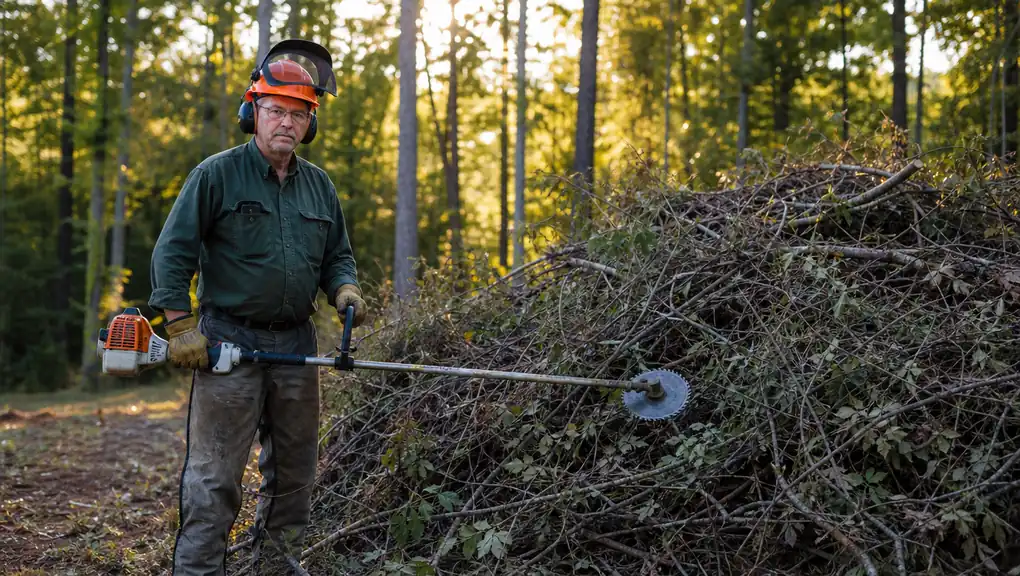
I bought the CALPALMY Brush Cutter Blade Kit for one reason: my fence line was disappearing. Privet, blackberry bramble and sweetgum saplings had rolled over about 300 feet of old cedar posts, and my string trimmer head was laughing at it. I am 61, I have a bad knee, and I do not have the patience to fight ten-foot privet one string at a time. So I bolted a steel blade onto my straight-shaft trimmer and found out exactly what this kit will and will not do.
The short version: the CALPALMY kit is the real thing for woody brush up to about the thickness of your thumb, it is not a toy, and it will flat-out scare you the first time you hit a hidden stump. I have spent two seasons on it across my 22 acres outside Crossville, Tennessee, and I would buy it again. But I would also tell you exactly where it stops being the right tool, because the listing photos do not.
The Quick Verdict
A serious, well-made blade kit that turns a straight-shaft trimmer into a brush cutter. Buy it for privet, briars and saplings. Do not buy it expecting to fell trees or grind stumps.
Amazon Check Today's Price →If you clear brush every spring, this is the upgrade that pays for itself in one afternoon.
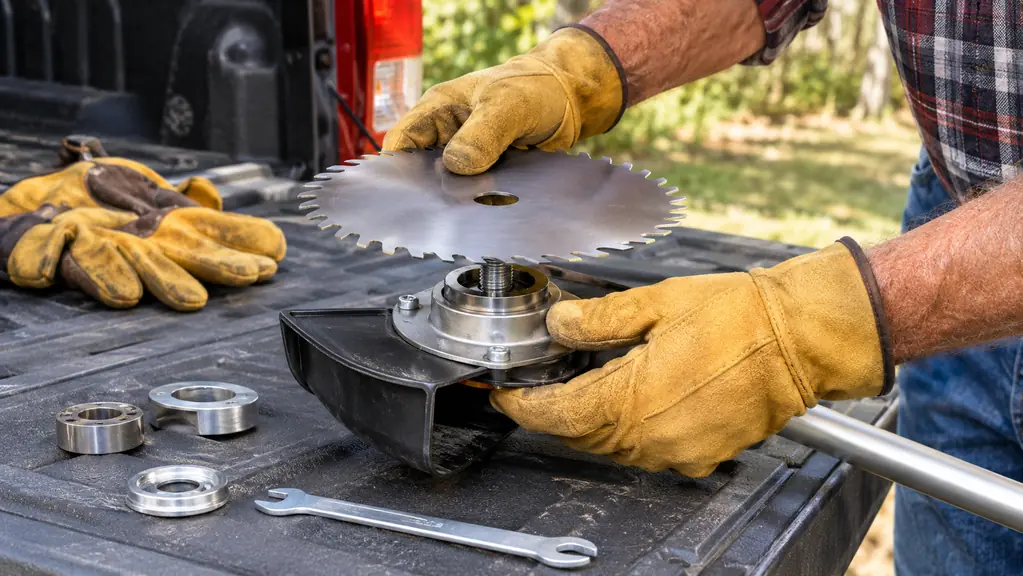
The CALPALMY kit ships with three blades and two universal adapter sets, so most straight-shaft trimmers with a 1-inch arbor can run it. I had mine on the head in under twenty minutes.
Amazon Check Today's Price on Amazon →How I've Used It
Let me be plain about the setup. The kit includes three alloy steel blades: a 9-inch 20-tooth, a 9-inch 36-tooth, and a 10-inch 80-tooth. It also includes two sets of universal adapter hardware with thrust washers, which is the part that matters. My straight-shaft trimmer has a 1-inch arbor, and the adapters let me mount all three blades without buying anything else. The whole kit weighs 1.76 kg, which is heavier than it sounds when you are holding the box, but you stop noticing once the blade is spinning and doing the cutting. The listing says it is made for wood and vegetation and fits trimmers, weed eaters, chainsaws and brush cutters except ECHO SRM series models. I cannot speak to every machine on that list, but on my setup it bolted up clean in under twenty minutes.
I put the 20-tooth blade on the first Saturday in April, the morning after a hard rain. The ground was soft, the privet along the north fence was head-high, and I had told Carol I would be back in for lunch. I was not back in for lunch. The first ten feet were a learning curve. You do not sweep a blade side to side the way you do with string. You let it cut and you move forward at a walking pace, keeping the head low and steady. By the time I stopped for water, I had cleared a stretch I had been putting off for two years, and I had also caught a half-buried rock hard enough that the whole machine kicked and I shut it down to check the blade. The alloy steel held. The blade was fine. My heart rate took a while to come down.
I ran the 9-inch 20-tooth first, because fewer teeth usually means it keeps its bite in thick stuff. That is the blade that did the real work on privet and blackberry. The 36-tooth was my everyday blade for mixed weeds and light saplings. The 80-tooth 10-inch blade is the one I reach for when I want a cleaner cut on grass-heavy ground, and it is also the one that throws the most debris, so I slow down with it.
I also learned the hard way to clear the ground before I start. A blade will happily cut through a two-inch sweetgum sapling, but it does not care whether that sapling is standing or lying flat in a pile of briars. Hidden wire, fence staples and old t-post clips are the enemy. I found a piece of barbed wire the second week and it nicked the 36-tooth blade. Nothing broke, but I slowed way down after that. From then on I walked every new stretch first, kicking aside rocks and pulling loose wire, and I still found surprises. On the third Saturday, a dead black locust branch snapped and threw a chunk back at my shins. The shin guard caught it. That was the day I stopped treating the safety gear as optional.
A typical session for me runs about two hours. I walk the stretch first, then I work the blade low and steady, stopping every few minutes to clear wrapped vines off the shaft. Privet wraps around the head like it is trying to climb it, and if you let it build up the blade starts to bog. I keep a pocket knife in my hip pocket for exactly that. At the end of a session I take the blade off, wipe it down, and check the teeth for nicks. In two full seasons I have not had to sharpen one yet, which tells me the alloy steel is doing its job.
What the Kit Actually Does Well
The honest headline is this: the CALPALMY kit turns a trimmer into a brush cutter for a fraction of what a dedicated brush cutter costs. On privet up to about an inch thick, the 20-tooth blade went through it like it was not there. Blackberry bramble, honeysuckle, multiflora rose, all of it folded. Sweetgum saplings up to two inches at the base took a few seconds each, and cedar branches up to an inch were no problem. I cleared a section of fence line in one afternoon that would have taken me three weekends with string. The only thing it does not like is wet, green grass in deep piles, which balls up under the guard and makes you stop to clean it out.
Let me give you a number. The north fence line, about 140 feet of it, had been buried under privet and briars for the better part of a decade. I started on it at seven-thirty one morning with the 20-tooth blade and a full tank of fuel. By ten o'clock I could see the cedar posts again for the first time since I bought the place in 2019. I counted eleven sweetgum saplings in that stretch, the biggest maybe two inches at the base, and every one of them went down in under ten seconds. With string, I would have been out there three weekends and still have been picking blackberry canes out of my gloves.
The adapter kit is the part I did not expect to be this good. Universal fitment hardware is usually where cheap kits fall apart, with washers that do not sit flat and arbor holes that are a hair off. Both sets in this kit went on true, and I have swapped blades maybe a dozen times without rounding out a single hole. That matters, because a blade that wobbles at full trimmer speed is a blade that throws itself off the head. I torque the nut down with a wrench every time, and I check it again after the first few minutes of running. I have never had one come loose.
The 9-inch 20-tooth blade went through two-inch sweetgum saplings in seconds. That is not a marketing sentence. That is what it did.
What It Does Not Do, and What Nobody Tells You
Now the part that does not show up in the listing photos. This is a blade kit, not a forestry mulcher. It will not fell a four-inch tree. It will not grind a stump. It will not chew through a downed log. I tried it on a three-inch cedar one Sunday afternoon in May, a tree I should have known better than to touch. The blade cut in about an inch before the trimmer bogged down and I backed off. The blade was fine, the tree is still standing, and I went and got the chainsaw like I should have done in the first place. On anything bigger than two inches at the base, I still reach for my chainsaw. That is not a failure of the product. It is a failure of expectations, and the listing does not do much to fix that.
The other thing nobody tells you is the kickback. A string head bounces off a stump and you barely notice. A steel blade bounces off a stump and the machine jerks hard in your hands. The worst one I had was a locust stump hidden under honeysuckle, maybe four inches across and cut flat years ago. I hit it at a bad angle and the trimmer kicked up and to the left hard enough that I had to step back and reset my grip. You have to hold the shaft with both hands, keep the head below your knees, and never, ever let the blade contact anything above ankle height. I wore chaps, eye protection and steel-toe boots every time. This is not a tool for a loose grip or a distracted afternoon.
Debris is the second thing nobody tells you. A string head throws grass. A blade throws wood chips, rocks and pieces of blackberry cane like shrapnel. The first time I hit a rock, I felt it ping off my shin guard. After that I cleared every work area by hand before I started cutting, and I still found surprises. I keep a spare pair of safety glasses in the truck because I learned that lesson the hard way too. A piece of cane caught me across the cheek on the second day, and the glasses I was wearing took the hit. If I had been squinting into the sun instead, that would have been my eye.
And the third thing: this kit will test your trimmer. My old straight-shaft unit handled it, but I could feel the strain in thick stuff, and I would not run the 10-inch 80-tooth blade on a lightweight homeowner machine for hours at a time. If your trimmer is already tired, the blade will find the weakness. You are asking a machine designed for string to spin a chunk of alloy steel, and it will let you know. A neighbor borrowed the kit, ran it on a cheap electric trimmer, and burned the motor out in about twenty minutes. I told him to stick to string. He did not listen.

The Three Blades, and When to Use Each
The 9-inch 20-tooth blade is the brute. Fewer teeth, bigger gullets, and it keeps cutting when the material is thick and nasty. This is the one I used for privet, blackberry and saplings. It is also the one that vibrates the most, and after a long session my hands felt it. I put in a full morning with it on the east line and by lunch my forearms were telling me to switch to the 36-tooth.
The 9-inch 36-tooth blade is the all-rounder. It cuts grass and weeds cleanly, handles light brush, and runs smoother than the 20-tooth. This is the blade I left on the trimmer most of the season for mixed ground. It is the one I would hand to somebody who has never run a blade before, because it is the most forgiving of the three.
The 10-inch 80-tooth blade is the finisher. It gives the cleanest cut on grass-heavy ground and edges along the fence line nicely. It is also the most aggressive at throwing debris, so I used it only when I had the ground cleared and the right safety gear on. If I had to keep just one blade, it would be the 36-tooth. But having all three means I never have to stop and switch machines for a different job. The adapter sets live in a zipper bag in the shed so the washers do not get lost between swaps.
What I Liked
- Three blades cover thick brush, mixed ground and finish work without switching machines
- Universal adapter kits with thrust washers fit straight-shaft trimmers with a 1-inch arbor
- Alloy steel blades took rocks, barbed wire and two full seasons without sharpening
- Cuts privet, briars and saplings up to about two inches at the base
- A fraction of the cost of a dedicated brush cutter
Where It Falls Short
- Will not fell trees over two inches or grind stumps, you still need a chainsaw
- Kickback is violent, demands two hands and a low head position
- Throws debris hard, so the work area has to be cleared first
- Strains lightweight trimmers, especially with the 10-inch 80-tooth blade
- Does not fit ECHO SRM series models
Who This Is For
This kit is for the rural landowner who clears their own ground and is tired of fighting brush with string. If you have privet, briars, honeysuckle or saplings along a fence line, and you already own a straight-shaft trimmer with a 1-inch arbor, the CALPALMY kit is a cheap way to make that trimmer do a job it could not do before. It is also for the person who understands that this is a cutting tool, not a toy, and will wear the gear and keep both hands on the machine.
I am 61 years old with a knee that complains, and this kit has saved me hours of stooping and yanking. I cleared a collapsed fence line that had been buried for years, and I did it standing up, moving at a walk. For that alone, it earns its place in my shed. Carol noticed the difference from the kitchen window before I even mentioned it, and that is the kind of proof I trust.
Who Should Skip It
Skip it if you want to fell trees or grind stumps, because this is not that tool. Skip it if you have a lightweight trimmer you are not willing to push, because the blade will find its limits. Skip it if you are not willing to clear the ground first and wear real safety gear, because this blade will hurt you if you disrespect it. And skip it if you have an ECHO SRM series trimmer, because the listing says it does not fit those models, and I have no reason to doubt that. And skip it if you are the kind of person who likes to find a tool's limits by pushing past them. This blade will show you its limits in a way you will remember.
I will also say this plainly: if your property is mostly four-inch trees and bigger, or if you have acres of standing timber to clear, rent a skid steer with a mulcher or hire somebody. The CALPALMY kit is a homeowner tool with homeowner limits. Knowing that before you buy is the whole point of an honest review. I rent a mulcher once a year for the worst of it, and I use this kit for everything in between. The two tools are not competitors. They are partners.
The kit that made my fence line visible again.
Three blades, two adapter sets, and two seasons of hard use without a failure. If you clear brush by hand, this is the honest upgrade.
Amazon Check Today's Price on Amazon →