
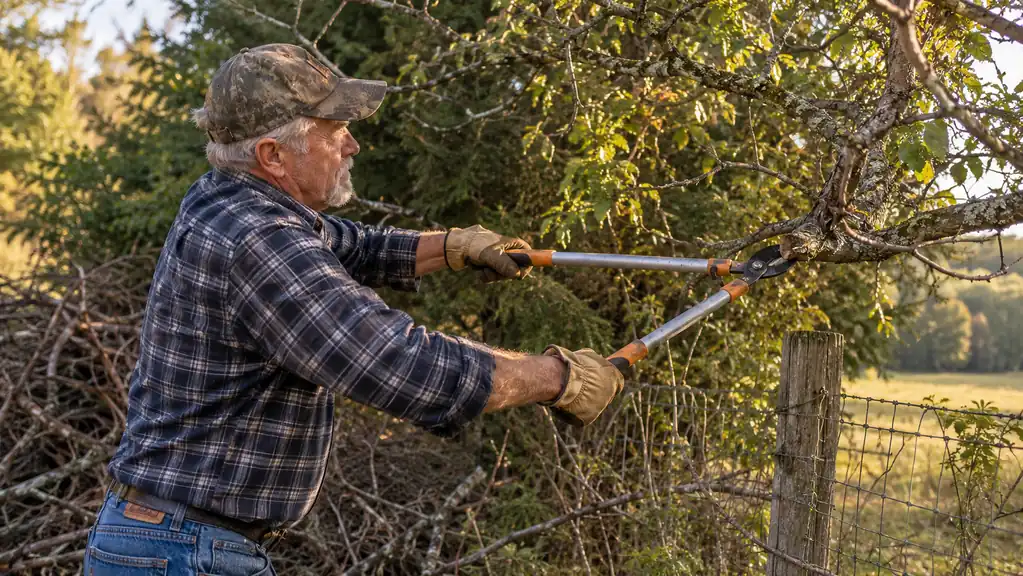
I will start with the part most reviews skip: the Fiskars PowerGear2 loppers are a fine tool, and they are also the most oversold tool in my shed. The box says a 2-inch cut capacity. The marketing says it glides through branches. What nobody tells you is that 2 inches is the ceiling, not the everyday. On a good day, with a green branch and a clean angle, these will take a solid 2-inch sweetgum limb. On a bad day, with a dead cedar branch and the cut slightly off, they will fight you at an inch and a half. I have owned this pair for three years on 22 acres outside Crossville, Tennessee, and I have cut enough privet, blackberry bramble and sweetgum to fill a dump truck. Here is what the Fiskars PowerGear2 loppers actually do, what they do not do, and where I reach for a saw instead.
I bought my pair in the spring of 2023, the same year I finally admitted the fenceline along the back of the property was not going to clear itself. Privet had been running wild along it for years. I had a compact utility tractor, a pickup truck, and a bad back from thirty years on a county road crew. I needed a tool that could cut all day without making my hands ache. The Fiskars PowerGear2 loppers were the obvious choice, and I do not regret the purchase. I just wish somebody had told me the truth about what a lopper can and cannot do before I spent a full Saturday fighting a cedar stump with a tool that was never meant for the job.
The Quick Verdict
The Fiskars PowerGear2 loppers are the best brush-clearing hand tool I own for green growth up to 2 inches, but they are a lopper, not a saw. Buy them for privet, bramble and saplings. Rent a clearing saw for the stumps.
Amazon Check Today's Price →The loppers I reach for every single time
After three years of weekend clearing, the Fiskars PowerGear2 loppers are still the first tool I grab for privet, bramble and saplings up to 2 inches. If you are clearing your own ground, this is the pair to start with.
Amazon Check Today's Price on Amazon →How I Have Used These Loppers
My section of Tennessee is mostly privet, blackberry bramble, sweetgum saplings and old cedar along a collapsed fence line. I have used the Fiskars PowerGear2 loppers on all of it, plus a few jobs I should have used a saw for. The tool is a 32-inch bypass lopper with a steel blade and a low-friction coating, and it weighs 3.9 pounds. The handles are aluminum with SoftGrip pads, and the geometry is what makes the tool worth owning. The PowerGear2 mechanism multiplies the force at the blade, so a 61-year-old with tired hands can cut through a 2-inch green branch without bouncing on the handles. The first real test came on a Saturday in April 2023, when I set out to clear the stretch of fence behind the house. The privet had been left alone for the better part of a decade, and the main stems were running 1.5 to 2 inches at the base. I figured I would be done by noon. I was still out there at four, but the loppers never let me down. I counted 47 stems cut that day, and I only stopped twice to wipe sap off the blade. The gear mechanism did what the box promised, and my hands still worked the next morning. That was the day I stopped worrying about whether I had bought the right tool. That stretch of fence has stayed clear ever since, which is the real measure of a clean cut. I have cut a lot of privet since, but I still measure every new tool against that first afternoon.
The honest summary is this: for green wood up to 2 inches, the Fiskars PowerGear2 loppers are excellent. For dead wood, for anything over 2 inches, or for anything at an awkward angle, they are the wrong tool. The blade is a bypass blade, which means it slices past a fixed jaw like scissors. That design gives a cleaner cut on living wood than an anvil lopper, and it is better for the plant. But a bypass blade demands a clean approach. If the branch is twisted, if you are reaching over a bramble, or if the wood is dead and brittle, the blade can bind or tear. I have learned to read the branch before I cut. That is the skill nobody puts in the product description.
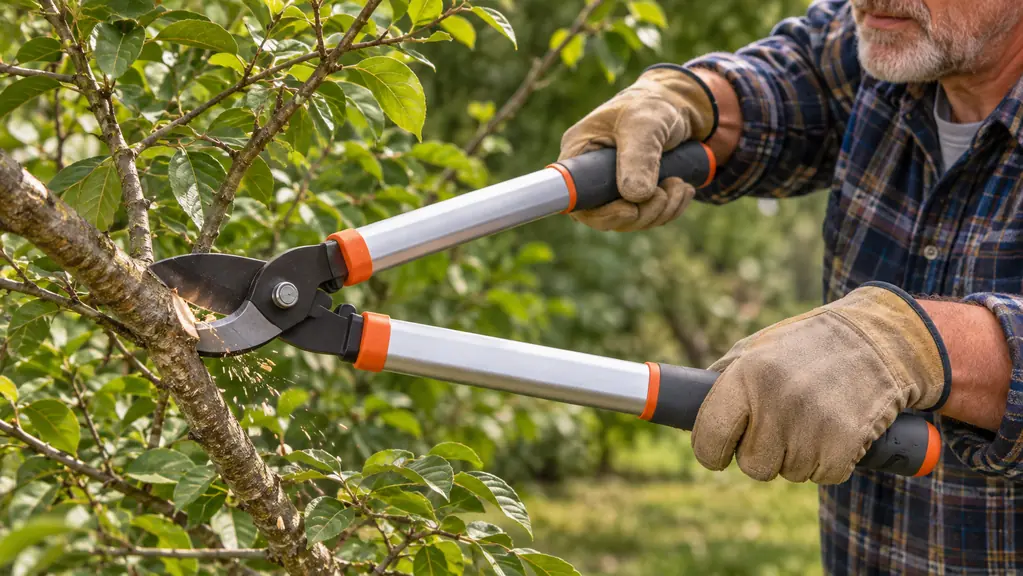
The low-friction coating on the blade is not marketing fluff. I have cut hundreds of privet stems with this pair and the blade still sheds sap and debris without gumming up. The SoftGrip handles do what they claim: after a full afternoon of cutting, my hands do not ache the way they did with my old cheap loppers. The ambidextrous design means I can switch hands when one side gets tired. These details matter more than the cut capacity, honestly, because the tool only works if you can keep using it.
What the Fiskars PowerGear2 Loppers Actually Cut
Let me give you the real-world numbers from my property. Privet stems up to about 1.5 inches: one clean squeeze, every time. Blackberry bramble canes: effortless, and the bypass blade leaves a clean cut that does not shred the cane. Sweetgum saplings up to 2 inches: doable, but you want the branch at the right angle and you want to cut close to the trunk where the wood is firmer. Green oak and maple branches up to 2 inches: yes, with a satisfying pop. Dead cedar branches: frustrating. The wood is brittle and the bypass blade tends to crush rather than slice. I have learned to cut dead cedar with a saw. The point about the 2-inch limit came home on a Tuesday in June 2023, after a storm dropped a hickory limb across the gravel drive. The limb was 2 inches at the narrow end and closer to 3 where it had snapped. I used the Fiskars loppers to trim the branch stubs off the part I could haul, and every cut at 2 inches or under went through clean. The one cut I tried at 2.5 inches took three squeezes and left a crushed end. That was the day I stopped arguing with the spec sheet. The rating is honest, but it assumes a green branch, a clean angle, and the patience to seat the branch deep in the jaw. Give it those three things and it will cut all day. Deny it any one of them and you will be reaching for a saw. I have not tried to cut anything bigger since, and I will not.
The 2-inch cut capacity is real, but it is a maximum, not a comfortable working range. The comfortable working range is closer to 1.5 inches. That is not a criticism of Fiskars; it is physics. A 32-inch lopper with a 3.9-pound head cannot generate the same force at the blade as a 6-foot saw. What the PowerGear2 mechanism does is make the most of the leverage you have. I can feel the gear multiply my effort on a 2-inch branch, and it is genuinely impressive. But if you are clearing a property with a lot of 3-inch saplings, you need a saw, not a bigger lopper.
The honest truth: these loppers will take a 2-inch green branch all day long, but the comfortable working range is closer to 1.5 inches. Buy them for that, and you will not be disappointed.
Where the Fiskars PowerGear2 Loppers Fall Short
Here is what nobody tells you. The first is the cutting angle. To get a clean cut on a 2-inch branch, you need the branch positioned deep in the jaw, at a right angle to the blade. That is easy at waist height on a clear path. It is miserable when you are reaching through a blackberry bramble to cut a privet stem at ground level. The loppers will do it, but you will work for it. The worst example was a privet stem growing up through the middle of a blackberry thicket. The stem was barely an inch, an easy cut if I could get to it. But the bramble canes were shoulder high and armed with thorns, and the 32-inch loppers were too long to get into the gap. I spent twenty minutes working around the outside, cutting the bramble back first, then reaching in at an angle so steep the blade wanted to slide off the stem. I got the cut eventually, but a pair of hand pruners would have done it in ten seconds. The length that makes the loppers powerful at waist height is the same length that makes them clumsy at ground level. I keep a pair of hand pruners in my back pocket for exactly that situation now. That lesson cost me an afternoon, and it is the one I pass on to anyone who asks about these loppers. The second is dead wood. A bypass blade is designed for living wood. Dead branches, especially cedar and pine, tend to crush or splinter. I have ruined more than one cut by forcing a dead branch through the jaw. The third is the one nobody mentions in reviews: the tool is 32 inches long, and that length is a liability in dense brush. You cannot swing it in tight quarters. You end up cutting from awkward angles or reaching over the top of the bramble.
There is also the matter of the blade edge. The specs say the blade edge is serrated. That is a real feature, and it helps the blade bite into green wood instead of sliding off. But serrated edges are harder to sharpen than a straight edge. After three years of heavy use, my blade is still sharp enough for green wood, but I can tell it will need attention eventually. Fiskars includes a full lifetime warranty, which covers the tool, but a dull blade is a wear item in my book. I would rather have a blade I can sharpen easily than a serrated edge that cuts slightly better on day one.
The Long-Term Test: Three Years of Weekend Clearing
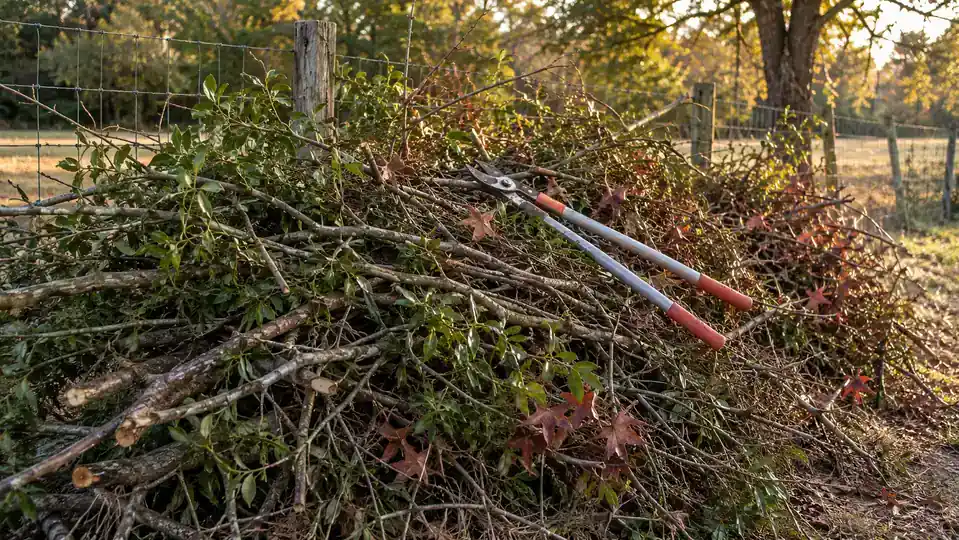
I have owned the Fiskars PowerGear2 loppers for three years. In that time, I have cleared roughly two acres of privet and bramble along the fenceline, plus countless sweetgum saplings in the pasture. The loppers have been dropped, left in the rain, and once run over by the tractor. The tractor incident happened in the fall of 2023. I had leaned the loppers against the rear tire while I went to fetch a chain, and when I came back the tractor had rolled forward a few feet and the loppers were under the tire. I expected a bent handle or a cracked jaw. What I found was a scrape on the aluminum and a small dent in one handle that does not affect the cut at all. I have dropped them off the tailgate more times than I can count, and they have spent more than one night in the rain because I forgot to put them away. The only maintenance I have done is wiping the blade down after use and occasionally tightening the pivot bolt, a quarter turn with a wrench every few months. That is the whole maintenance log. The gear mechanism still engages with a solid click, and the blade comes back to center cleanly. The aluminum handles are still straight. The SoftGrip pads are still intact. The blade still cuts cleanly. That is the real test of a tool: not how it performs on day one, but how it performs after three years of abuse.
The mechanism has not loosened. The gear still engages smoothly. The handles do not creak. I cannot say that about the cheap loppers I owned before, which developed play in the pivot after one season. The Fiskars PowerGear2 loppers feel like a tool that will outlast me, which is exactly what I want from a piece of equipment I keep in the truck bed. The full lifetime warranty is a nice peace of mind, but I have not needed to use it.
What I Liked
- Gear mechanism really does multiply cutting force on branches up to 2 inches
- Low-friction coated blade stays clean through sap-heavy privet and bramble
- SoftGrip handles stay comfortable through a full afternoon of cutting
- Aluminum handles and steel blade have survived three years of hard use
- Full lifetime warranty from Fiskars
- Ambidextrous design lets you switch hands when one side gets tired
Where It Falls Short
- Comfortable working range is closer to 1.5 inches, not the full 2 inches
- Bypass blade struggles with dead, brittle wood like cedar
- 32-inch length is awkward in dense brush
- Serrated edge is harder to sharpen than a straight edge
- Not a substitute for a saw on anything over 2 inches
Who This Is For
The Fiskars PowerGear2 loppers are for the person clearing their own ground, the way I am. If you have privet, blackberry bramble, honeysuckle or saplings up to about 2 inches, this is the tool. It is also for the person who wants to cut all day without their hands giving out. The gear mechanism and the SoftGrip handles make a real difference after hour three. And it is for the person who wants to buy one tool and keep it for the rest of their life. The Fiskars build quality and the full lifetime warranty make that a reasonable bet.
If you are a new acreage buyer looking at an overgrown property, I would put the Fiskars PowerGear2 loppers near the top of your first tool list, right behind a good chainsaw and a pair of work gloves. Start with the loppers for the brush, and you will be surprised how much ground you can cover in a weekend. The tool will not clear your property for you, but it will make the work feel possible.
Who Should Skip It
Skip the Fiskars PowerGear2 loppers if your property is mostly dead wood, large cedars, or anything over 2 inches in diameter. A bypass lopper is the wrong tool for that work. You need a clearing saw, a chainsaw, or a tractor with a brush hog. I learned this the hard way on a stand of dead cedar along the back fence. I spent a full afternoon fighting branches that a saw would have cut in minutes. The loppers are not a failure; they are a specialized tool. If your property does not match the specialization, do not buy them just because they are popular.
I would also skip them if you have serious hand or wrist problems. Even with the gear mechanism, cutting 2-inch branches all day takes effort. The PowerGear2 helps, but it does not make the work effortless. If you need a truly low-effort cut, look at a powered pruner instead. And if you are clearing a property that is mostly 3-inch saplings, skip the loppers entirely and rent a clearing saw for a weekend. It will cost less than your frustration.
The pair that earns its keep on 22 acres
Three years in, the Fiskars PowerGear2 loppers are still the first tool I grab for green brush up to 2 inches. If you are ready to start clearing your own ground, this is the pair to buy.
Amazon Check Today's Price on Amazon →