
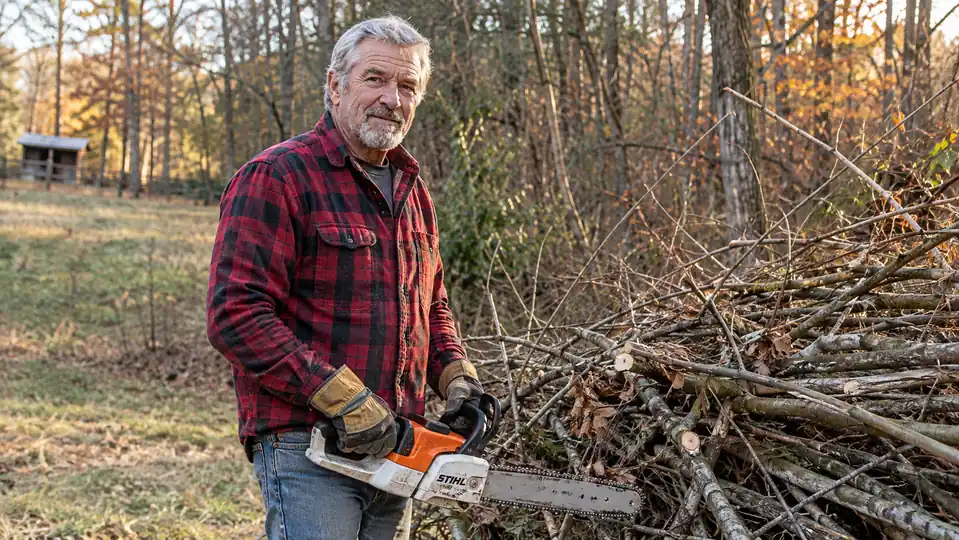
I'll start with the part most reviews skip: I bought this Greenworks 40V chainsaw for one job, and it turned out to be a different tool than I expected. Not worse, necessarily. Different. If you're clearing heavy brush and saplings on a few acres the way I am, you need to know what this saw will do before you hand over your money, because it will not do everything a gas saw will. That's not a flaw. It's a tradeoff, and it's worth understanding.
My name is Dale Kittredge. I'm 61, retired from the county road crew, and I live on 22 acres outside Crossville, Tennessee. I bought this place in 2019, and about six of those acres were a mess of privet, blackberry bramble, sweetgum saplings and old cedar along a collapsed fence line. I've been working through it in sections ever since. This chainsaw has been part of that work for two seasons now, and I've used it enough to have opinions.
I'll tell you right now that I was skeptical of battery saws. I'd used a couple of early ones that were underpowered and died halfway through a job. This one changed my mind, but not because it's magic. It's because it's honest about what it is. It's a light-duty saw that does light-duty work very well.
The Quick Verdict
A capable light-duty saw for brush and small trees, as long as you respect its limits and keep the battery charged.
Amazon Check Today's Price →The saw that cleared my fence line without a pull cord
If your property looks like mine did, this is the saw that makes the first pass feel doable. Check today's price on Amazon and see if it fits your work.
Amazon Check Today's Price on Amazon →How I've Used It
The saw is a 16-inch bar with a 1.5kW brushless motor, running off a 40V 4.0Ah lithium-ion battery. It weighs 10.4 pounds, which sounds light until you've held a saw at arm's length for an hour. I've used it mostly on saplings and brush, the kind of stuff that grows back faster than you can cut it. Privet stems, sweetgum saplings two or three inches thick, cedar that's been left alone too long. I've cut privet that was taller than my head, blackberry bramble that grabbed at everything, and cedar that had been left alone for a decade. The saw handled all of it.
The two-step start is the first thing you notice. No gas, no prime, no pull cord. You do the two-step start and it's running. For a man my age who has pulled more starter cords than he cares to count, that alone is worth something. The chain brake and low-kickback design are the kind of thing you hope you never need, but you're glad they're there when a branch catches wrong.
I keep the battery in the house when the saw is in the shed. The specs say it holds a charge for 12-plus months, and I've found that to be true as long as it's not sitting in a freezing shed all winter. I charge it the night before I plan to cut, and it's ready in the morning.
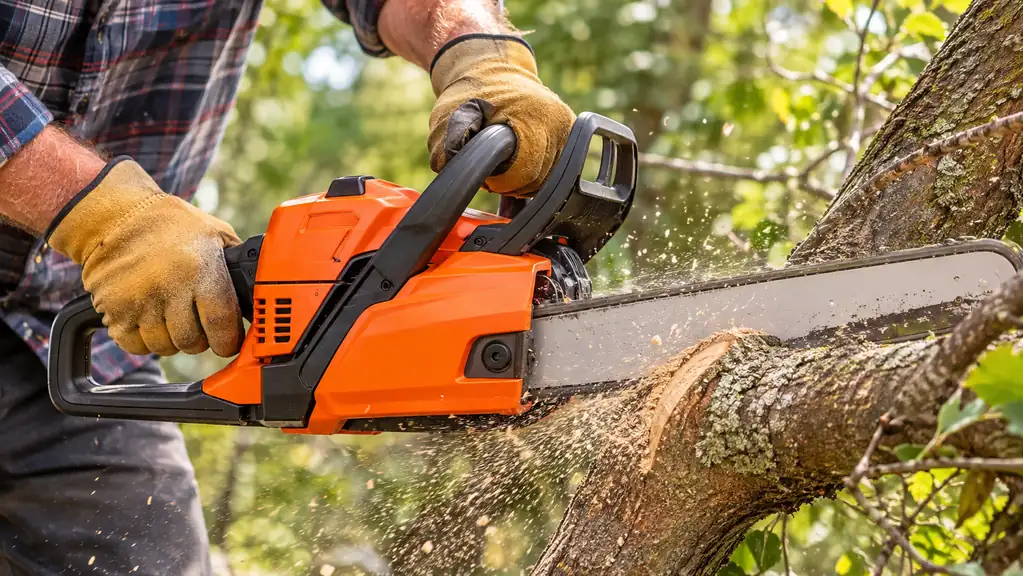
My first cut was a sweetgum sapling about three inches thick. I expected the saw to struggle a little, the way a small saw will. It didn't. The 1.5kW motor pulled through it in a few seconds, and the chips flew. I remember thinking that this was going to make the fence line a lot less intimidating. The second thing I noticed was how clean the cut was. No tearing, no fighting. The low-kickback chain and the 16-inch bar are a good match for this size of work. I made a few cuts on privet that afternoon, and by the end of the day I had a respectable brush pile.
What the Specs Don't Tell You
The automatic oiler is a good example. The listing mentions it, but it doesn't tell you what it means in practice. It means you don't have to remember to oil the chain before every cut. It also means you should check the oil before you start, because the saw will happily run with a dry bar if you let it. I learned that the hard way on a hot afternoon.
The other thing nobody tells you is how the weight feels. 10.4 pounds on a spec sheet is one thing. In your hands, cutting overhead branches or reaching into a bramble patch, it's another. The saw is balanced well enough, but it's still a saw. You'll feel it in your shoulders by the end of a long session.
And that 28-inch claim. The listing says it handles trees and limbs up to 28 inches in diameter. I'll be honest: I wouldn't want to be the one holding it when it's cutting something that big. For anything over about 8 or 10 inches, I reach for something bigger or call a friend with a gas saw. The 16-inch bar is perfect for what I do, which is mostly stuff under 6 inches.
Chain tension is something you'll deal with more than you'd like. A new chain stretches, and you have to stay on top of it. I check mine every time I check the oil, and I keep the saw's manual in the shed so I don't have to guess at the right adjustment.
Runtime and Battery Reality
Runtime is where the honest reviews separate from the marketing. With a 4.0Ah battery, I get a solid stretch of cutting on a full charge. It's not all-day, and it's not meant to be. I plan my work in sessions: cut for a while, let the saw rest, cut some more. When the battery runs low, I plug it in and go do something else for a while.
The battery holds a charge for 12-plus months, which is a real advantage over gas. I can pick up the saw in March after it's sat since November, and it starts. Try that with a gas saw that's been sitting with old fuel in the carburetor.
Cold weather is the thing to watch. A cold battery does not cut like a warm one. I've learned to keep the battery inside until I'm ready to use it, especially on those 30-degree mornings in Tennessee. It's a small habit that makes a real difference.
Battery care is simple but important. I store it indoors, out of the cold, and I don't leave it on the charger for weeks at a time. The included charger does the job without fuss, and I keep it in the same place as the battery so I don't have to hunt for it. The 3-year warranty covers the saw, and I treat the battery like the part that actually makes the tool useful.
What It Does Well
For brush and saplings, this saw is hard to beat. The 16-inch bar and the 1.5kW motor chew through privet and sweetgum like they're not there. The low-kickback chain and the chain brake mean I can work in tight spots without feeling like the saw is going to get away from me.
The included components are all you need to get started: the saw, a battery, a charger, and a manual. The 3-year warranty is a real thing, and it's the kind of coverage that makes a battery tool feel less like a gamble. I haven't had to use it, but knowing it's there for three years takes the edge off. The included manual is clear and honest, which is more than I can say for some tools I've owned.
The automatic oiler is another quiet win. It keeps the chain lubricated without me having to think about it, which is exactly what I want when I'm halfway into a bramble patch. I check the oil before I start, and that's it.
The chain brake is one of those features you don't appreciate until you need it. I had a branch catch the bar once and kick back hard. The brake stopped the chain before I even had time to react. That's the kind of thing that makes a homeowner saw worth owning, and it's why I'd recommend this to someone who's not a professional.
What It Does Not Do
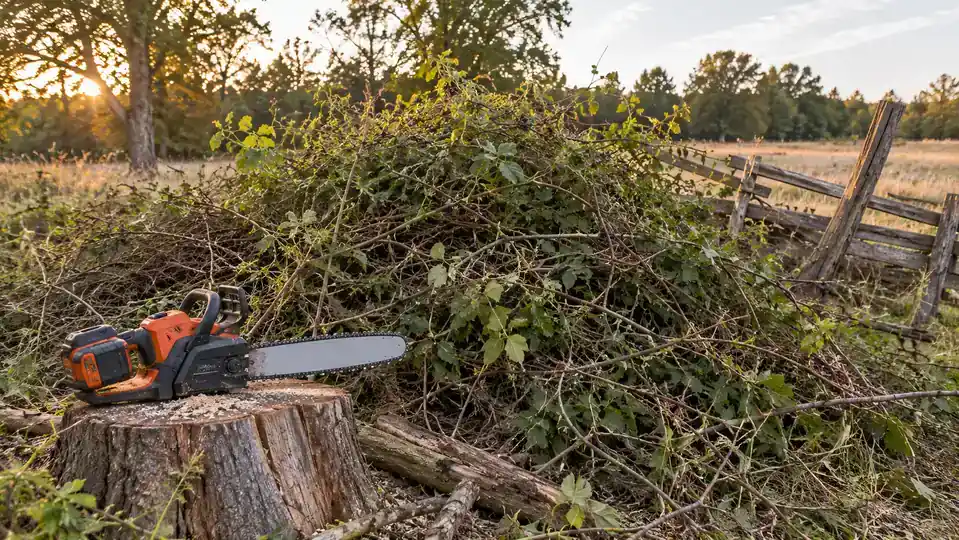
Here's the part that gets left out of the glossy reviews. This is not a felling saw. It's not going to drop a 20-inch oak, and it's not going to mill lumber. The 16-inch bar is a limitation, and the battery is a limitation. If your property has big trees that need to come down, rent a gas saw or hire someone. This saw is for the work that happens between the big jobs.
The other thing it does not do is run forever. If you're used to a gas saw that runs as long as you can hold it, the battery will be a change. I've learned to work in bursts, and honestly, the breaks are good for my back. But if you're planning to clear a whole hillside in one afternoon, you'll be waiting on a charger.
I grew up on gas saws. My father had a Stihl that he used for everything, and I spent plenty of weekends on the business end of it. So I know what a gas saw does well. It runs all day, it has torque to spare, and it doesn't care about the temperature. This Greenworks is not that saw, and it's not trying to be. What it does better than gas is the everyday stuff. It starts instantly, it's quiet enough that I can hear the birds, and there's no fuel to mix or store. I don't miss the smell of gas on my hands, and I don't miss the pull cord that always seems to fight back on a cold morning.
The tradeoff is runtime and raw power. A gas saw will out-cut this battery saw in a long session, and it will handle bigger wood. But for the work I do, the Greenworks is enough. I'd rather have a saw that starts every time and handles 90 percent of my cutting than a saw that has more power than I need and sits in the shed because it's a hassle to start.
What I Liked
- Starts every time with a two-step button, no gas and no pull cord
- Light enough at 10.4 pounds to handle for a full session
- Battery holds a charge for 12-plus months when stored properly
- Automatic oiler keeps the chain lubricated without fuss
- Chain brake and low-kickback design add confidence
Where It Falls Short
- Battery runtime is limited; plan your work in sessions
- 16-inch bar means it is not for felling big timber
- Chain tension needs regular attention, especially on a new chain
- The 28-inch diameter claim in the listing is optimistic for real-world use
The battery holds a charge for 12-plus months, and I can pick up the saw in March after it's sat since November, and it starts. Try that with a gas saw.
Who This Is For
If you've got a few acres of brush, saplings, and overgrown fence lines, and you want a saw that starts every time without a fight, this Greenworks is a solid fit. It's light enough to handle, quieter than a gas saw, and the battery means no fuel to store and no stale gas to deal with.
It's also a good choice if you're new to chainsaws. The 2-step start removes the intimidation factor, and the chain brake and low-kickback design give you a margin for error. I'd still take a safety course, but this is a forgiving saw to learn on.
Say you've got a half-mile of fence line that's grown over with privet and blackberry. That's my situation. This saw makes that job a series of manageable sessions instead of one overwhelming project. You cut a section, you move brush, you cut another section. The battery gives you a natural stopping point, which is honestly good for your back and your patience.
Who Should Skip It
If you're a logger, a firewood cutter, or someone who needs to fell big timber, skip it. You'll be frustrated by the battery and the bar length. If you have a hundred acres of mature woods to manage, this is not your main saw. It might be your second saw, the one you grab for quick jobs, but it's not the one you'd build a season around.
And if you're the kind of person who refuses to plan ahead, the battery will annoy you. You can't just grab the saw and go. You have to check the charge, check the oil, and think about how long you'll be out there. For me, that's a fair trade for never pulling a cord again. For some people, it's a dealbreaker.
If you heat with wood and cut your own firewood, this is not the saw for that. You'll want something with more bar and more runtime. This saw is for clearing, not for producing a winter's worth of fuel.
The Bottom Line
After two seasons, here's my honest bottom line. The Greenworks 40V chainsaw is a good saw for the work it's designed to do. It starts every time, it cuts brush and saplings with ease, and it doesn't ask for much in return. The battery is the tradeoff, and the bar length is the limit. If you understand both, you'll be happy with it.
I use mine a couple of times a month, and it's earned its place in the shed. It's not the saw I'd grab for a weekend of firewood, but it's the saw I reach for when the fence line starts to grow back. For that job, it's the right tool.
If a neighbor asked me whether to buy this saw, I'd say yes, with two conditions. First, understand that it's for brush and saplings, not for felling timber. Second, plan to charge the battery before you start. If you can live with those two things, you'll wonder why you ever fought with a pull cord.
See if it fits your property
If your land looks like mine did, this is the saw that makes the first pass feel doable. Check today's price on Amazon and see the current deal.
Amazon Check Today's Price on Amazon →