
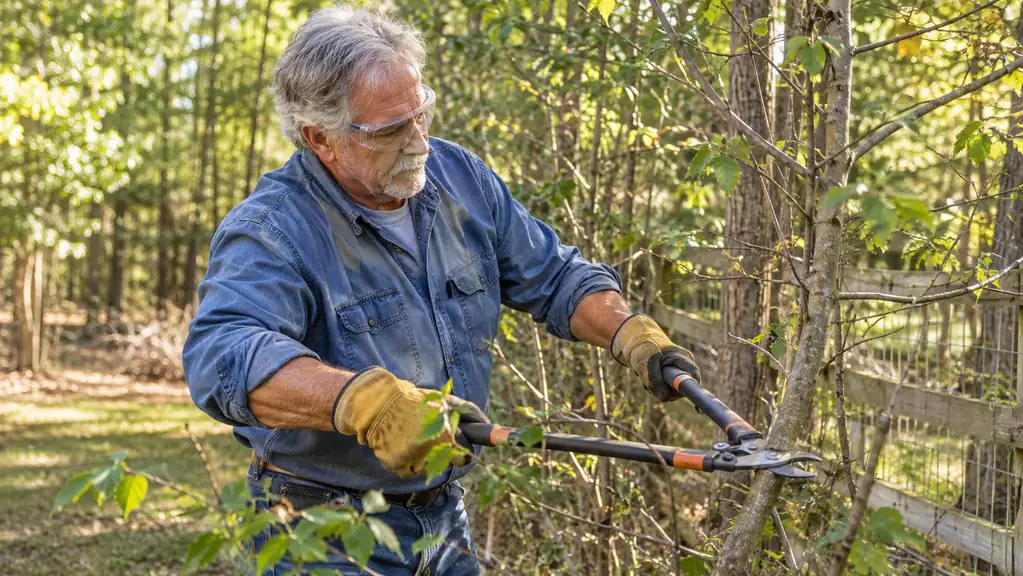
Buying your first piece of wooded ground is exciting right up until you walk the fence line and see what ten years of neglect looks like. Privet thick enough to hide a deer, blackberry canes grabbing at your pant legs, sweetgum saplings as thick as your wrist, and old cedar posts buried under it all. I bought 22 acres outside Crossville, Tennessee back in 2019, and about six of those acres looked exactly like that. My first thought was to hire someone with a forestry mulcher to come in and grind it all down. My second thought was the cost of that. My third thought was that I had retired from the county road crew with thirty years of running equipment behind me, and if I could not clear my own fence line, who could? So I started clearing it myself, one section at a time, with a pickup truck, a compact utility tractor, and a battery chainsaw I bought on a hunch. This is the step-by-step way I did it, and what the Greenworks 40V chainsaw can and cannot do when the job is real.
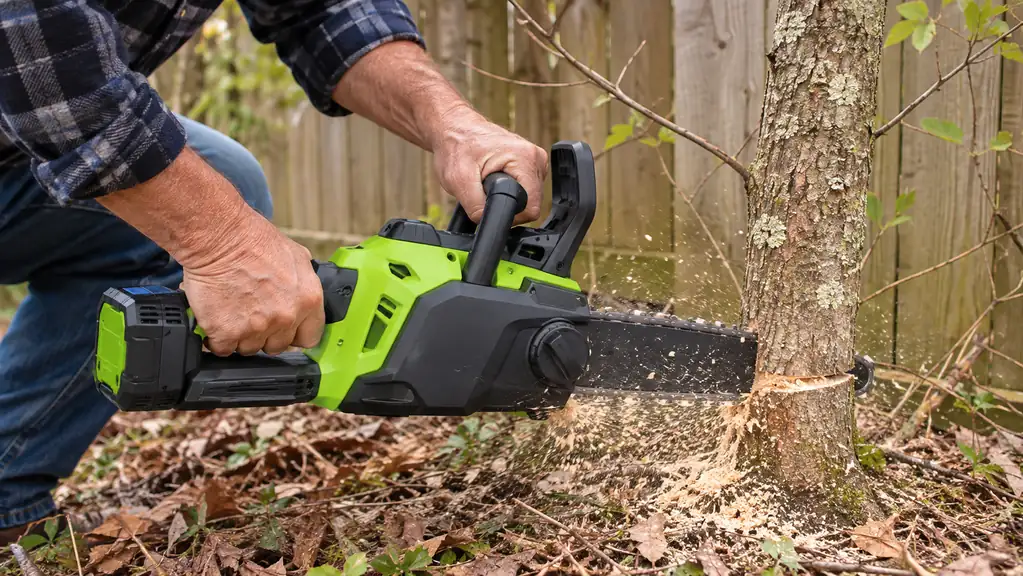
Before we get into the steps, let me be clear about what this saw is and what it is not. It is a 16-inch battery chainsaw with a brushless motor, a 40V 4.0Ah lithium-ion battery, and an automatic oiler. It starts with a two-step easy start, so there is no gas to mix, no primer bulb to pump, and no pull cord to yank. It is not a replacement for a big gas saw, and I will tell you exactly where it runs out of steam. But for clearing saplings, cutting brush, and limbing trees you have already dropped, it has done more honest work on my place than I ever expected from a battery tool. It is also quiet enough that I can hear Carol holler from the house, which is more than I could say for the gas saws I used to run on the crew.
The saw I reach for first on my fence line
The Greenworks 40V 16-inch brushless chainsaw with the 4.0Ah battery and charger included is the one I keep charged and ready for clearing work. No gas to mix, no primer bulb, no pull cord. Just the two-step start and a bar that goes through saplings in one pass.
Amazon Check Today's Price on Amazon →Step 1: Walk the line and mark what stays
Walk the whole fence line before you cut anything. I know it feels like wasted time, especially when you are standing there with a new saw and a full battery. But it is the difference between a weekend of steady work and a weekend of surprises. On my first pass I found a buried water line from an old county easement, a strand of barbed wire hidden in the privet, and the remains of a gate I did not know existed. Any one of those would have made for a bad day with a chainsaw. All three of them would have been a trip to the emergency room.
Mark the trees you want to keep with flagging tape before you start cutting. Mark anything you are not sure about and decide later. Do not cut first and think second. On my place I flagged a row of young oaks along the north line and worked around them. It takes ten minutes and it saves you from cutting something you will miss for the next twenty years. When the brush is gone and you can finally see the property, the trees you kept are the ones that make it look like a place, not just a clearing.
Take a look at the ground conditions while you are walking. After a wet week, the low spots along my line turned to mud, and I spent more time pulling my boots out than I did cutting. Pick a dry stretch if you can. If you cannot, at least know where the soft ground is before you drag a saw and a battery into it.
Step 2: Dress for the work and check the saw
Long pants, sturdy boots, work gloves, eye protection, and hearing protection. I wear all of it even when I am only cutting for ten minutes. A chainsaw does not care that you are in a hurry, and the one time you skip the glasses is the time a chip finds your eye. I spent thirty years on a county road crew, and every guy I worked with who got hurt with a saw was the guy who was just going to make one quick cut. I keep a spare pair of gloves in the truck because the first pair will be soaked through by noon.
Check the chain tension and the oil before you start. The Greenworks has an automatic oiler, which means you do not have to remember to oil the bar by hand, but you do have to keep the reservoir full. I check it every time I recharge the battery, and I keep a can of bar and chain oil on the shelf in the shed. It takes thirty seconds and it keeps the bar from overheating on a long afternoon.
The two-step easy start is one of the reasons I reach for this saw as often as I do. No gas to mix, no primer bulb to pump, no pull cord to yank. It starts cold, every time, which sounds like a small thing until you have spent twenty minutes fighting a stubborn gas saw in July. The chain brake is there for a reason too, and I test mine before I start cutting each session. The low-kickback design is another reason this saw feels less jumpy than the old gas saws I ran on the crew. It is still a chainsaw, and I still respect it, but it does not fight you.
Step 3: Clear the underbrush first, then the saplings
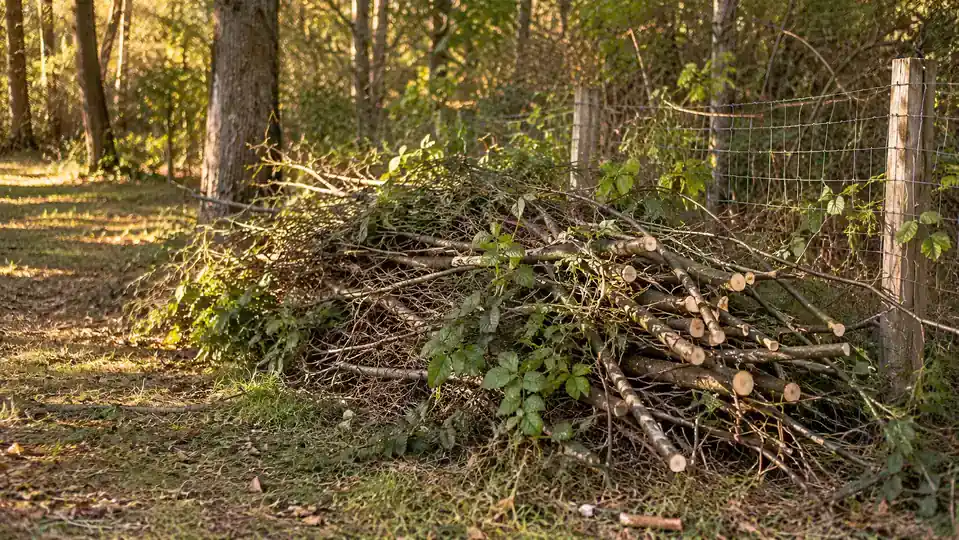
Start with the privet and the blackberry canes. They tangle around your legs and hide what is underneath, and if you try to cut the saplings first you will be fighting the brush the whole time. I cut the low stuff with the saw and toss it onto the brush pile as I go. It is not tidy work, but it opens the ground so you can see what you are doing. Once the underbrush is down, the fence line starts to look like a place you can actually walk.
Then the saplings. This is where the Greenworks earns its keep. A 16-inch bar with a brushless motor will go through a sweetgum sapling as thick as your wrist in one pass. I cut them at ground level so I am not leaving stubs to trip on or snag a mower later. The saw weighs 10.4 pounds, so you are not fighting the tool while you are trying to aim it. By the end of the first afternoon I had a pile of saplings as tall as I am and a battery that was still going.
Work in a straight line along the fence. You want a clear corridor, wide enough to walk and, later, wide enough to drive a tractor down. I aimed for about six feet of clear ground on my side of the line. It took me two weekends to do a quarter mile, and I was not hurrying. The second weekend was faster than the first, because the corridor was already open. I stacked the cut saplings in piles of roughly the same length, which made them easier to drag to the burn pile later.
Step 4: Handle the bigger stuff with a plan
Once the small stuff is gone, you will see what is actually there. On my line it was old cedars and a few sweetgums six to eight inches thick. The Greenworks is rated for trees and limbs up to 28 inches in diameter, and I do not doubt it can cut them. But a rating is not a plan. I cut the bigger trees with a plan, a clear escape route, and a direction in mind before I ever started cutting. That plan starts with looking up. A leaning tree can surprise you, and a dead limb overhead can come down while you are cutting something else entirely.
For anything thicker than my thigh, I cut a notch on the side facing the direction I want the tree to fall, then cut from the opposite side and step back as it goes. I keep my escape route clear before I start, and I never cut alone. Carol knows where I am and checks on me if I am out too long. That is not dramatic, it is just what you do when you work alone on your own land. A tree does not care how long you have been doing this.
And for the rare tree that is genuinely too big for a 16-inch bar, I do not pretend otherwise. I cut it in sections, or I rent a bigger saw for the day. The Greenworks does the daily work on my place, and it does not have to do everything. Knowing its limits is why it has lasted this long on my property, and why I still reach for it first when I head down to the line.
Step 5: Keep the line clear and the saw ready
The first pass is not the end of the job. Privet comes back, blackberry canes come back, and sweetgum seedlings will sprout wherever you cut. I do a maintenance pass every few weeks during the growing season, and each pass is faster than the last. The corridor stays open, the fence line looks like someone owns it, and the property line is actually visible for the first time since I bought the place.
The 40V 4.0Ah battery holds its charge for 12 months or more, so I keep one charged and the saw ready in the shed. When the battery runs low, the included charger tops it up while I take a break and drink some water. At 10.4 pounds, the saw is light enough to carry the whole way down the line without your arm going dead, which matters more than you think by the end of a long afternoon. The included components are simple: the saw, the battery, the charger, and the manual. That is everything you need to get started. I charge the battery after every session, not before, so it is always ready when I am.
I keep the manual in the shed with the saw. It sounds obvious, but most people lose it in the first week. When I need to adjust the chain or check the oiler, the manual is right there. The three-year warranty is a comfort too, but I have not needed it yet.
What Else Helps
A chainsaw alone will not clear a fence line. What made the difference for me was a compact utility tractor with a bucket for dragging brush piles and moving cut logs, a good pair of loppers for the stuff too small to justify a saw, flagging tape, a pry bar for old fence posts, and a first aid kit in the truck. I already owned the tractor and the truck. The rest of it is cheap, and it is the difference between a cleared line and a pile of frustration. If you do not have a tractor, a heavy-duty tarp and a strong back will get the brush to the burn pile. And I will say this plainly: if you have a mile of heavy timber and a deadline, call someone with a mulcher. For a fence line and a few weekends, do it yourself. You will know the ground better when you are done.
The Greenworks went through wrist-thick sweetgum saplings in one pass, and at 10.4 pounds I carried it the whole length of my fence line without my arm giving out.
Ready to start on your own fence line?
The Greenworks 40V chainsaw with the 4.0Ah battery and charger included is the saw I keep charged and ready in the shed. It starts cold, cuts through saplings in one pass, and it does not sit there because it is too much trouble to start. For clearing your own ground, that is what you want.
Amazon Check Today's Price on Amazon →