
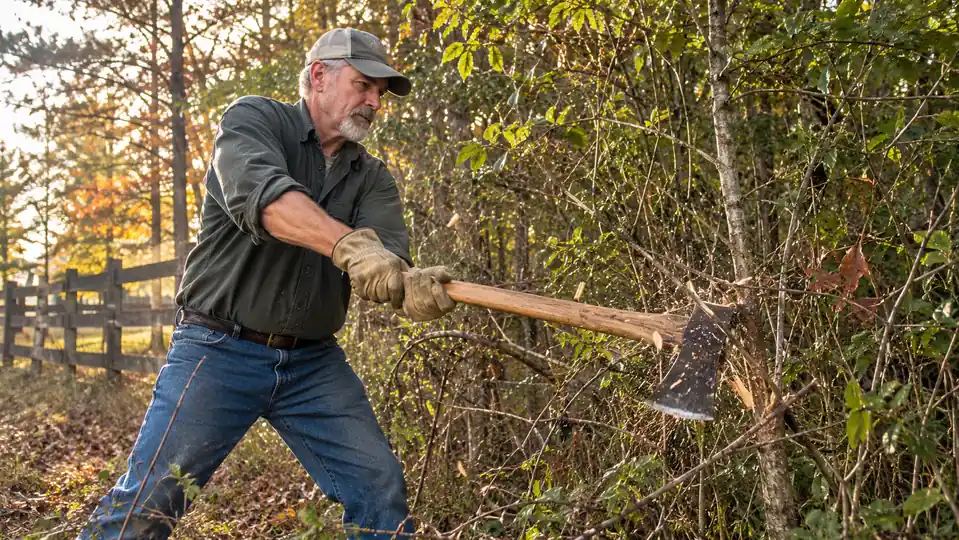
I bought my 22 acres outside Crossville, Tennessee in 2019, and about six of them were a solid wall of privet, blackberry bramble, sweetgum saplings, and old cedar along a collapsed fence line. It had been let go for years, and by the time I took over, you could not walk the property line without fighting for every step. I have been working through it in sections ever since, and the Fiskars brush axe is the hand tool I have reached for more than any other in that fight. After three seasons with it, I can tell you exactly what it will do for you and what it will not.
There is a reason most reviews of this tool sound alike. It does one job very well, and that job is the first pass through a thicket. What nobody tells you is how much of the work still comes down to your back, your knees, and your patience. This is the honest version, from a retired county road crew foreman who clears his own ground and has no reason to sugarcoat a tool.
The Quick Verdict
The best hand tool I have found for the first pass through saplings and bramble, as long as you do not ask it to do a chainsaw's job.
Amazon Check Today's Price →The brush axe that earns its place in the truck
After three seasons clearing privet, sweetgum, and blackberry bramble, this is the tool I grab first. Light enough to carry all day, sharp enough to make the work go fast, and backed by a lifetime warranty.
Amazon Check Today's Price on Amazon →How I've Used It
The fence line behind the barn is where I started. The privet had been left alone for years and had grown into a wall about eight feet tall and maybe forty feet long. A machete just bounced off it. A chainsaw was overkill for the small stuff and a nuisance to start and stop every few minutes. The Fiskars brush axe was the middle ground I did not know existed.
I use it one-handed with a short, controlled swing, letting the curve of the blade do the work. It cuts on the pull as much as the push, which took me a while to get the feel of. Once I did, I could work through a patch of privet at a pace that surprised me. I keep it in the truck, not the barn, because I use it every time I walk the property.
The creek trail took an afternoon. There were sweetgum saplings everywhere, most of them no thicker than my thumb, some as thick as my wrist. I worked down one side and then the other, and by the time the light went flat, I had a path you could walk without ducking. That is the thing about this tool. It turns a job you have been putting off into a job you can finish in a day.
The blackberry bramble along the old fence line was the worst of it. Blackberry canes grab at your pants and your sleeves, and they hide the fence posts you are trying to reach. I found the best way was to cut the canes at the base first, then pull the dead tops away with a gloved hand. The brush axe handled the base cuts faster than anything else I tried, and it did not bind up the way a machete did.
What It Actually Is
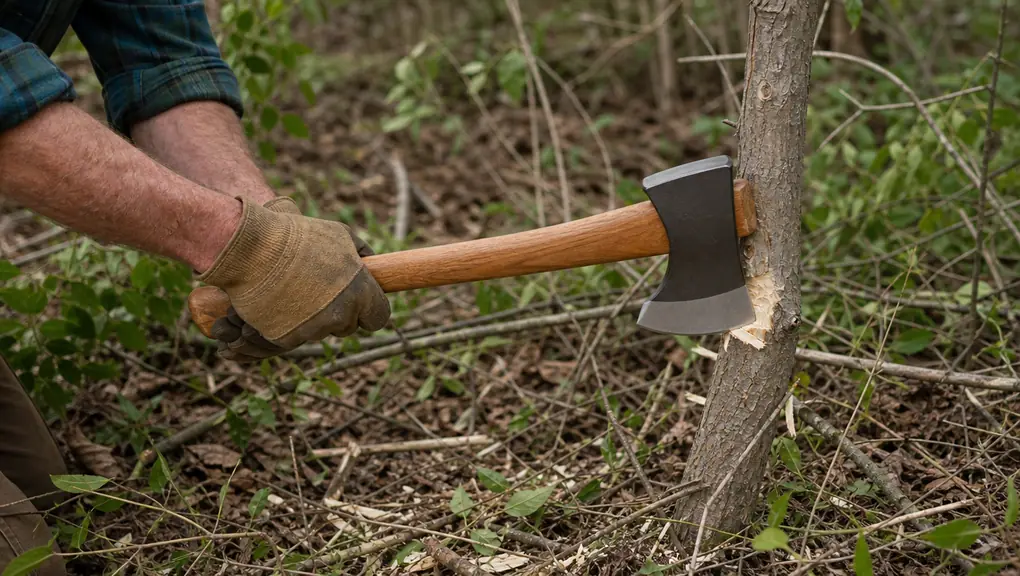
The Fiskars brush axe is a 10-inch curved blade on a 19-inch FiberComp handle, with a stainless steel edge and a felling-style head. If you have never held one, it sits somewhere between a machete and a hatchet, and it is not quite either. The handle is short enough that you swing it with one hand, and the curve lets the blade bite into a sapling instead of glancing off.
The blade comes sharp, and the low-friction coating helps it slide through green wood instead of sticking. That coating sounds like marketing until you have used a plain steel blade on a wet privet stem. The difference is real. The blade is insert-molded into the handle, which means there is no separate head that can work loose the way a traditional axe head can.
It also comes with a safety sheath, and I would not carry it in the truck without one. The blade is genuinely sharp, and a loose blade in a truck bed is how people get cut. The sheath is simple, it stays on, and it takes two seconds to put on or take off.
One thing to understand before you buy: this is not a machete, and it is not a hatchet. A machete is longer, lighter, and made for slashing at grass and light brush. A hatchet is made for chopping wood. The brush axe is made for cutting woody stems up to a couple of inches thick, and that is a job neither of the other two does well. The FiberComp handle is balanced so the weight sits right at the blade, which is what makes the one-handed swing work.
Where It Earned Its Keep
Sweetgum saplings up to about wrist-thick are this tool's best work. One swing cuts most of them, and a second swing finishes the job. The curved blade hooks the stem and pulls through it, which is why it cuts so much better than a straight machete on the same material.
The features list says it is ideal for clearing brush, cutting trails, stripping logs, and felling, and I have used it for all of those. Stripping branches off a downed cedar is something I did not expect it to be good at, but the curve hooks around the branch and pops it off cleanly. I have also used it to open up the blackberry bramble along the old fence line, which is miserable work with any tool. The bramble grabs at everything, and the brush axe cuts through the canes at the base where they are woody and tough.
The insert-molded blade has not loosened at all, and I have put it through three seasons of hard use. The edge needs touching up now and then, which is true of any cutting tool, but it has not chipped or rolled in a way that worried me. I have had cheaper brush axes where the head worked loose after a few weekends, and this one has not moved.
It is also the tool I grab for small jobs that do not justify a chainsaw. Cutting back a branch that overhangs the driveway, clearing the spot where I park the tractor, opening up a view of the creek from the porch. Those jobs used to pile up because starting a chainsaw felt like too much trouble. Now they take five minutes.
The Honest Limits
Here is what nobody tells you. This tool will not cut anything much thicker than your wrist, and it will not dig out roots. I have tried both, and I am telling you not to waste your time. For anything bigger, I reach for the chainsaw. For roots and stumps, I reach for a shovel, a grub hoe, or the tractor.
It is also a one-hand tool, which means it has a short reach. You will do a lot of bending, and after a long day your knees will remind you that you are not thirty anymore. The 19-inch handle is part of what makes it light and easy to control, but it also keeps you low to the ground. If you have back trouble, this tool will find it.
You have to keep the edge sharp. It is sharp out of the box, and the stainless steel holds an edge reasonably well, but a brush axe that has been used hard on privet and sweetgum is not going to stay razor sharp on its own. I touch mine up with a file a few times a season, and that takes ten minutes. A dull brush axe is just a heavy stick. The FiberComp handle is tough, but it is not a pry bar and it is not a wedge. I have seen people use a brush axe to split kindling or lever out a root, and that is how handles break. Use the tool for the job it was made for and it will last.
One more honest note about safety. The blade is sharp enough that it will cut you before you know it happened, especially when it is wet. I wear a glove on my off hand, I keep the sheath on whenever I am walking with it, and I never carry it blade-up over my shoulder. That last one is how people cut the back of their neck, and it is not worth learning the hard way. And when the job is beyond a hand tool, call a pro. Big cedars, stumps, anything near a structure or a power line, that is not the time to prove a point with a brush axe. I rent a forestry mulcher for the big jobs, and I use the Fiskars for the work that a machine cannot do efficiently. Knowing the difference between the two is what keeps you safe.
What I Liked
- Cuts saplings and bramble fast with one hand, no chainsaw needed
- Light at 1.2 pounds, easy to carry all day
- Insert-molded blade will not work loose
- Low-friction coating helps it glide through green wood
- Safety sheath and full lifetime warranty included
Where It Falls Short
- Won't cut anything much thicker than your wrist
- Won't dig out roots or stumps
- Short 19-inch handle means bending for low cuts
- FiberComp handle is not a pry bar or wedge
- Edge needs regular touching up to stay sharp
The brush axe won't clear your property by itself. What it will do is make the first pass through a thicket fast enough that you actually finish the job.
Durability, Warranty, and the Long Haul
Fiskars backs this with a full lifetime warranty, which matters to me because I buy tools expecting to wear them out. The insert-molded blade is the part that usually fails on cheaper brush axes, where the head works loose after a season. That has not happened here, and the warranty covers it if it ever does.
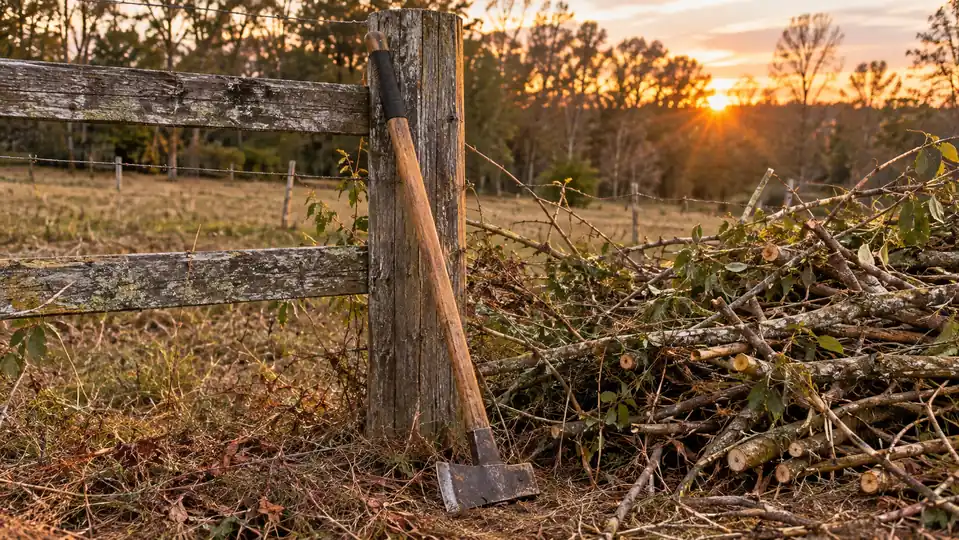
The 1.2-pound weight means I do not think twice about carrying it on a walk around the property, and the sheath means I can toss it in the truck without worrying about it cutting something. Three years in, mine looks used but solid. The handle has no cracks, the blade is still firmly seated, and the coating is worn in places but still doing its job.
I will also say this about Fiskars as a company. I have owned their tools for years, and I have never had to use a warranty claim. That is not a guarantee, but it tells you something about how they build things. The brush axe is built the same way.
One small thing worth mentioning. The instruction guide that comes with it is short and worth reading, because it shows the right way to grip and swing. Most tools do not need instructions. This one benefits from them, because the technique is not obvious to someone who has only used a machete or a hatchet.
Who This Is For
If you own a few acres and you clear your own brush, this is for you. It is for the person who is tired of a machete bouncing off privet and does not want to fire up a chainsaw for every sapling. It is light enough to carry all day, sharp enough to make real progress, and backed by a lifetime warranty.
It is also for the person who walks their property line once a week and wants a tool that lives in the truck. You will use it more than you expect, because it turns a five-minute nuisance into a thirty-second fix. That is the real value of a good hand tool. It does not just do the job. It gets you to do the job.
One more type of person this fits: the weekend landowner who inherited an overgrown property and does not know where to start. This tool is a good first purchase because it is easy to learn, it does not need fuel or maintenance the way power equipment does, and it will not sit in the barn unused. You will find reasons to pick it up.
Who Should Skip It
If you need to clear mature trees, grub out stumps, or open up a large field, this is not the tool for that job, and no brush axe is. If you want a tool for thick blackberry canes that you can swing two-handed, a heavier machete or a sling blade might suit you better. And if you are not willing to keep an edge sharp, you will be frustrated with any cutting tool, this one included.
I would also say this. If you are buying a brush axe because you have one big clearing job and you think this will make it easy, set your expectations now. It will make the work faster and less frustrating, but it will not make it easy. The tool is honest about that. You should be too.
Bottom line from a guy who has spent three years on the business end of this tool: the Fiskars brush axe is not the answer to every clearing problem on a wooded property, but it is the answer to more of them than I expected. It lives in my truck, it has earned its keep a hundred times over, and I would buy it again without a second thought.
If you clear your own ground, this belongs in your truck
I have used mine for three seasons on privet, sweetgum, and blackberry bramble. It does what it says, it is still going strong, and the warranty backs it for life.
Amazon Check Today's Price on Amazon →