
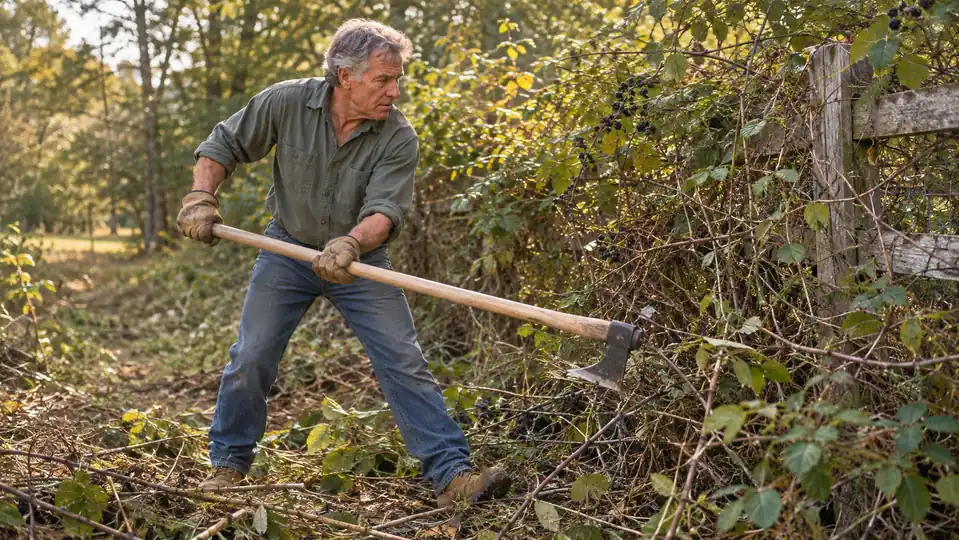
When we bought the 22 acres outside Crossville back in 2019, maybe six of them were a solid wall of blackberry bramble, privet, and sweetgum saplings running along the old fence line. The way the canes had woven together, you could not walk through it, and you could not see the fence at all. I tried a string trimmer first and it just shredded the canes into a mess that grew back angrier. I tried a chainsaw and learned fast that a saw wants wood that holds still. What finally made the job go right was a Fiskars brush axe, the 19-inch model with the curved 10-inch blade, once I figured out the order of work that matches how bramble actually grows.
This guide is for the person in the same spot I was in. You are not clearing a hundred acres with a forestry mulcher. You are opening up a fence line, cutting a trail through the woods, or pushing the brambles back from the yard before they take over. The Fiskars brush axe will not fell a tree and it will not dig out a stump. What it does, better than anything I have used in thirty years of working outdoors, is cut the stuff that is too thick for a mower and too floppy for a chainsaw. Take it from somebody who spent thirty years running a road crew: the right tool in the right order makes all the difference. Here is the step-by-step method I settled on, in the order that actually works.
The tool I reach for first when the brambles take over
The Fiskars 19-inch Brush Axe with its curved 10-inch blade cuts through blackberry canes and saplings in one swing, and the fiberglass handle keeps the weight down to 1.2 pounds. It is the tool that cleared my fence line, and it comes with a full lifetime warranty. Check today's price on Amazon.
Amazon Check Today's Price on Amazon →Why a Brush Axe Beats the Alternatives
I owned all the other options before I bought the Fiskars, so I am not guessing when I say this. A string trimmer with a blade attachment just beats the canes up and leaves a jagged mess that grows back worse. A chainsaw is dangerous on anything that bends, because the cane twists and pinches the bar. A machete works, but the blade is too short to keep you out of the thorns, and the straight handle gives you no leverage on a thick crown. The brush axe splits the difference: a 19-inch handle for reach, a curved blade that hooks the cane, and enough weight to cut through without wearing out your arm.
The other thing I will say for the Fiskars specifically is the build. The blade is insert-molded into the handle, which means there is no head to loosen and no joint to fail. I have swung mine hard enough to bury the blade in a cedar root, and the tool did not flinch. The fiberglass handle flexes a little, which takes the sting out of the cut, and the low-friction coating keeps the blade from sticking in green wood. That is the difference between a tool you use and a tool you fight.
Step 1: Suit Up and Read the Ground
Before you swing anything, walk the whole stretch you plan to clear and look at what is actually in it. Blackberry bramble loves to hide old fence wire, t-posts, and the occasional piece of trash that blew in years ago. I found a roll of barbed wire in my first section that would have ruined my day if I had hit it blind. Walk the line, kick at the thickest spots, and mark anything metal with a flag or a stick. It took me one afternoon to learn that lesson, and I would rather you learn it from this page than from a snagged blade.
Dress for the work. Long pants, heavy work boots, and gloves you can still feel through. I wear safety glasses too, because a blackberry cane will whip back at you when it lets go, and a thorn in the eye is not how I want to spend a weekend. The Fiskars comes with a safety sheath for the blade, and I put it on any time I stop to move a branch or take a drink.
Start at one end of the mess and work in a straight line toward the other end. Do not jump around. If you clear in sections, you can see your progress, and you always know where you have already cut. A brush axe is a one-swing-at-a-time tool, and a steady line beats a random attack every time.
Step 2: Cut the Top Canes First
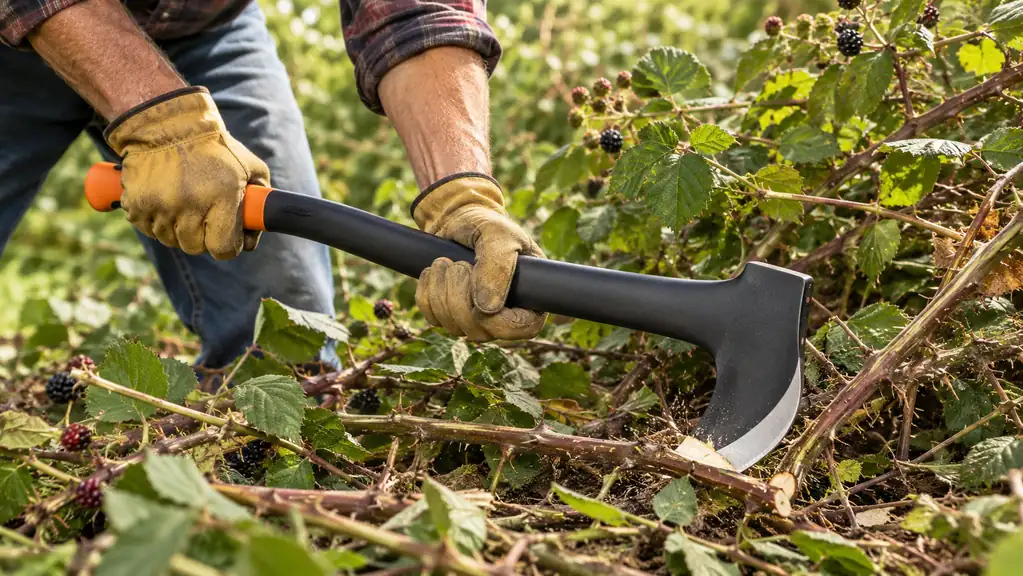
The mistake most people make with blackberry is trying to cut the thick base of the cane first. The canes are woven together at the top, and if you do not cut that tangle loose, the whole thing just bends and springs back. Start high. Reach into the bramble and cut the top growth first, letting each cane drop as you go. The curved blade on the Fiskars hooks into the tangle and slices it clean. Do not try to power through the whole patch at once. Work a section you can finish, then move to the next.
The blade is sharp out of the box, and the low-friction coating helps it glide through the wood instead of binding. You can feel the difference on the second or third swing. A dull blade pushes the cane down and makes you fight it. A sharp blade cuts it and moves on. I keep a file in the truck and give the edge a few strokes when I stop for lunch.
Work from the outside of the patch toward the middle. That way you are always cutting at the edge of the tangle instead of buried in it, and you can see what you are doing. As the top growth comes down, the patch starts to open up, and you can finally see the crowns where the real work begins.
Step 3: Work the Crowns at Ground Level
Blackberry is a perennial. If you cut the canes and leave the crown, it sends up new canes next year and you start over. The crown is the woody knot at the base where all the canes come out of the ground. Miss it and you will be back next year doing the same work. The whole point of the ground pass is to cut each cane as close to the crown as you can get. This is where the brush axe earns its keep. The head is insert-molded into the handle, so it will not loosen, and you can swing it hard without worrying about the head flying off.
Get the blade down low and cut at an angle, letting the weight of the tool do the work. The Fiskars weighs 1.2 pounds, which does not sound like much until you have swung it a few hundred times. That matters more than it sounds. By the third hour, a heavy tool starts swinging itself and your form goes with it. The Fiskars stays where you put it. The light weight means you can keep good form all afternoon, and the 19-inch handle gives you the reach to stay out of the thorns while you work.
When you hit a crown that is too big for the axe, do not fight it. I keep a pair of loppers in the truck for the thickest crowns, and I cut those with two hands. The axe handles the vast majority of it, and the loppers finish the stubborn ones. Knowing when to switch tools is half the job.
Step 4: Clear as You Go and Stack the Pile
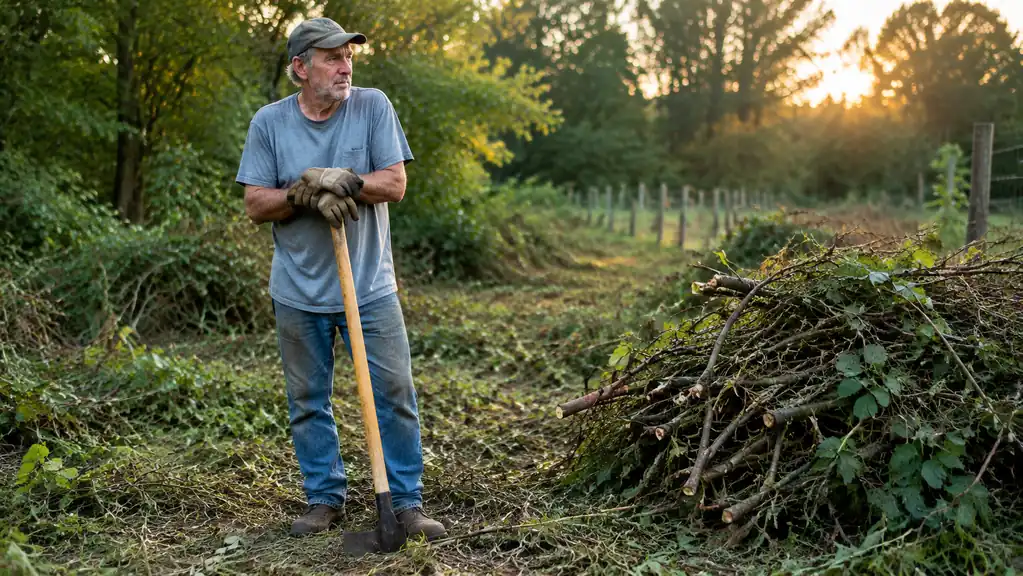
Do not let cut canes pile up where you are working. A blackberry cane on the ground is still armed, and you will trip on it or snag a boot. Every few swings, grab the cut canes by the base and toss them onto a pile. I stack mine along the fence line I am clearing, well away from where I am swinging. A clear work area is a safe work area, and it is faster too, because you are not stepping over what you just cut.
Build the pile so it is easy to deal with later. I lay the canes in the same direction, with the cut ends together, so I can fork them into the back of the pickup or drag them to the burn pile. If you are clearing a trail, keep the pile off the trail itself, or you will be moving it twice.
Take breaks before you are tired, not after. Swinging a brush axe is honest work, and your grip goes first. When my hands start to cramp, I walk back to the truck, drink some water, and put the sheath back on the blade while I rest. Fifteen minutes off keeps me going all day.
Step 5: Finish with a Pass in the Other Direction
When you think you are done, walk the cleared line again and look at it from the other direction. You will be surprised how many canes you missed. The ones that were leaning away from you get hidden by the ones you already cut. A second pass, cutting from the opposite angle, catches the stragglers and levels the ground. I have cleared a lot of ground in my time, and the second pass is the difference between a job that looks done and a job that is done.
This is also the pass where you cut the canes you knocked down but did not sever. I find them by walking the line slowly and kicking at the flattened growth. Anything that springs back up gets one more cut at the base. The curved blade makes this pass quick, because you can hook the cane and cut it in the same motion.
When the section is done, I wipe the blade down and put it back in the sheath. The stainless steel blade does not rust the way carbon steel does, and the fiberglass handle does not care about rain or mud. The Fiskars carries a full lifetime warranty, so I do not baby it, but I do keep it clean. I have had the same axe for three seasons now, and it still cuts like the day I bought it. A clean tool is a safe tool.
What Else Helps
The brush axe does the cutting, but a few other things make the job go smoother. Long pants and a long-sleeve shirt are not negotiable when you are working in bramble. I keep a pair of loppers in the truck for the thickest crowns, and once I have a big enough pile, I use the tractor to drag it to the burn area. The pickup handles what the tractor cannot. I also wait for a dry day. Wet bramble is slick, the canes are heavier, and the footing on a slope gets risky. What the brush axe is not is a stump grinder. If you have stumps the size of dinner plates, or you are clearing a hillside too steep to stand on safely, call somebody with a skid steer. There is no shame in renting a machine for the part of the job that needs one. The hand tools are for the parts you can do yourself, and that is most of it.
I cleared about 150 feet of fenceline in a long afternoon, and the Fiskars blade never needed a touch-up.
Ready to open up your fence line this weekend?
The Fiskars 19-inch Brush Axe is the tool I reach for first when the brambles take over. It cuts clean, it holds an edge, and it is backed by a full lifetime warranty. Check today's price on Amazon and see why it earned a permanent spot in my truck.
Amazon Check Today's Price on Amazon →